Showing posts with label 2008 Season. Show all posts
Showing posts with label 2008 Season. Show all posts
Saturday, March 14, 2009
Sunday, February 1, 2009
DDS207
Jeffrey Low and I spent a pleasant evening at my home today enjoying our shamas. At my request, he brought DDS207, one of Icon’s sons from last year. I hadn't seen him in surroundings outside Jeff's home and wanted to see how he would react to other shamas in a strange place.
Actually, neither Jeff nor I expected him to perform as he had only recently completed his molt and appeared to have no form as yet. This was evident from the pale insides of his beak.
As experienced shama keepers know, the inside beak will turn a very dark red to almost black when a bird is in form. The paler the inside beak the lesser the form. The pale beak indicates that the bird does not have the hormone, testosterone, which is necessary for the bird to sing and display well in the presence of other male shamas.
DDS207 surprised us both with his performance. At least he surprised me.
I will mention shortly about DDS207's performance. First, I would like to say something about Jeff's choice of him. When DDS207 was a juvenile, I had tried to dissuade Jeff from selecting him and to take one of my other young birds. Amongst others, I offered DDS206 and DDS225. I wanted to make sure that Jeff would not be disappointed with his shama from me.
It wasn’t that I thought DDS207 was not worth keeping. Far from it. I could see that he had a strong character, excellent display and very good structure. In fact, he seemed to have all the makings of a potential champion. Even when an aggressive Super Model was placed close to him, he had not been cowed.
My only reservation was that he had the shortest tails of any juvenile I had ever bred – 4½”. This is really short and I feared that the length of his adult tails might mirror his juvenile tails. While it was possible that his adult tails would be long I wished to be sure for Jeff's sake.
I knew of course that my shamas have long-tailed genes in them and even short juvenile tails do not necessarily mean that the adult tails would be short.
Super Model, for instance, had juvenile tails of only 4¾” but his adult tails, after the third molt, were over 12”. Nevertheless, knowing the amount of effort that needs to go into caring for a shama from juvenile to adulthood, I did not want Jeff to risk being disappointed.
Jeff had insisted on choosing DDS207. He acknowledged that its adult tails might not be as long as my other birds but he said that he was so impressed with DDS207’s other attributes that he was prepared to take a chance. He also said that even if DDS207's tails turned out to be short, he would not regret his choice.
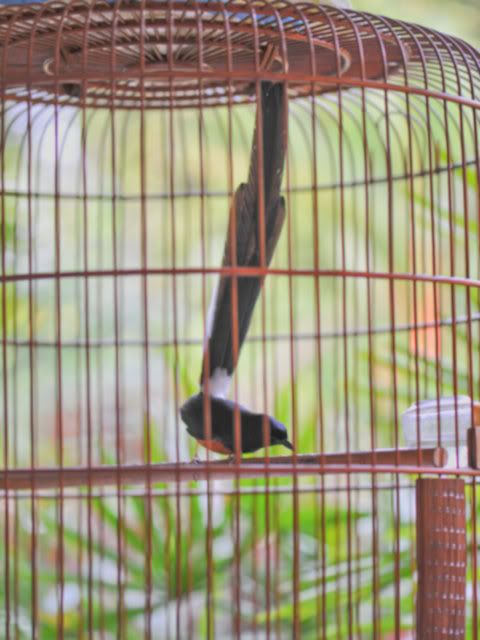
Well, I am relieved that DDS207’s tails have not disappointed. I would estimate them at presently about 11” after his molt from juvenile. They are soft and curved as you can see from the photograph below:
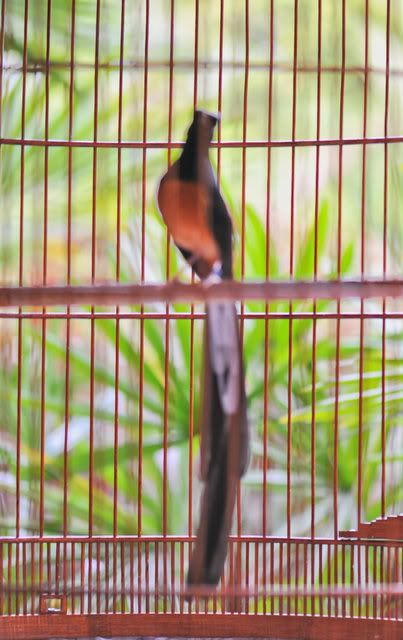
The photographs are badly taken as I was taking the photos quickly and had difficulty focusing on the bird through the bars of the cage. Nevertheless, I think the character and beauty of the bird shines through.
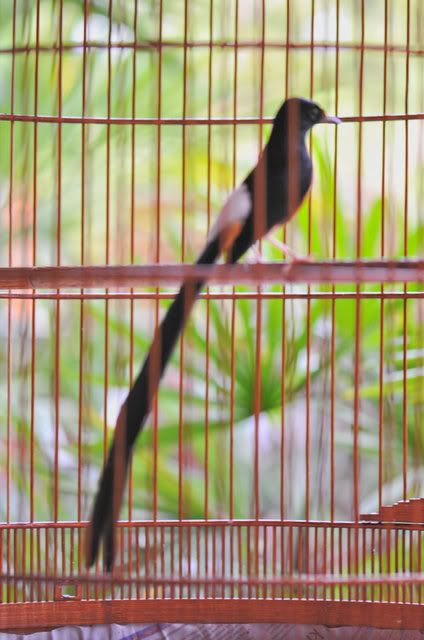
This was DDS207’s first trip in a vehicle. As is usual for birds that are not used to travel, when his cage cover was removed, his beak was slightly agape in stress. However, almost immediately, he straightened his body and burst into song when he heard my birds. Jeff looked at me and I smiled my surprise and appreciation.
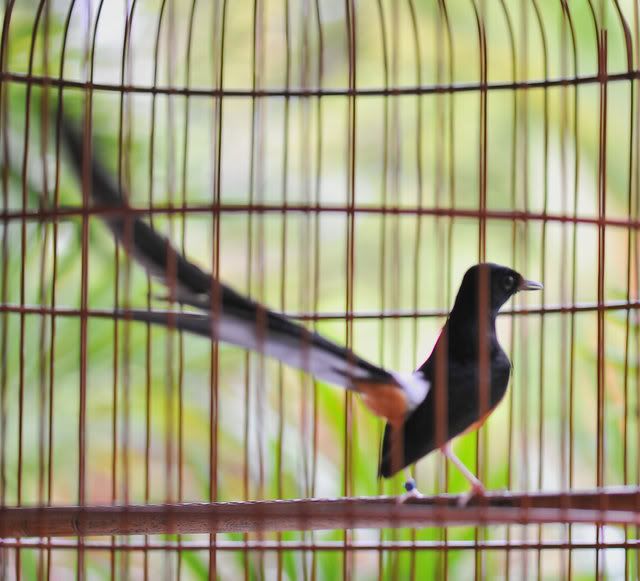
I then took out some of my young birds and DDS207 began to also display. He would lift his tails about 60 degrees and wave them in the air 3 to 4 times before lowering them while “playing the perch”. Jeffrey smiled happily like a proud father seeing his son do well in his first outing in sporting competition. I was happy for him.
After awhile, we decided to test the strength of DDS207's character by placing a seasoned in-form adult next to him. The only adult shama I had in a cage was a Medan type bird that had won several competitions in Indonesia and which is in good form. I had acquired him to be a tutor to my birds. I placed him next to DDS207 and he sang and displayed. DDS207 was not intimidated by the older bird and displayed and sang even more vigorously. This shows aggression and was impressive against an older in-form shama. He also aggressively dived to the cage floor every now and then as in the photo below:
He then had another surprise for us as he began to "play snake-head". For those who do not know what this means, an aggressive male shama may nod its head up and down, like a cobra does, when there is aother aggressive male shama close to it. Not all male shamas in top form exhibit this characteristic. It is beautiful to watch.
DDS207 continued to sing and display throughout the 2 hours or so that Jeff was at my home.

For a bird with as yet no form, his performance was extraordinary and shows the strong character that Jeff had seen in him when he was a juvenile. I can’t wait to see his full performance when he is in top form. I am glad that Jeff seems to have got the bird of his dreams.
Actually, neither Jeff nor I expected him to perform as he had only recently completed his molt and appeared to have no form as yet. This was evident from the pale insides of his beak.
As experienced shama keepers know, the inside beak will turn a very dark red to almost black when a bird is in form. The paler the inside beak the lesser the form. The pale beak indicates that the bird does not have the hormone, testosterone, which is necessary for the bird to sing and display well in the presence of other male shamas.
DDS207 surprised us both with his performance. At least he surprised me.
I will mention shortly about DDS207's performance. First, I would like to say something about Jeff's choice of him. When DDS207 was a juvenile, I had tried to dissuade Jeff from selecting him and to take one of my other young birds. Amongst others, I offered DDS206 and DDS225. I wanted to make sure that Jeff would not be disappointed with his shama from me.
It wasn’t that I thought DDS207 was not worth keeping. Far from it. I could see that he had a strong character, excellent display and very good structure. In fact, he seemed to have all the makings of a potential champion. Even when an aggressive Super Model was placed close to him, he had not been cowed.
My only reservation was that he had the shortest tails of any juvenile I had ever bred – 4½”. This is really short and I feared that the length of his adult tails might mirror his juvenile tails. While it was possible that his adult tails would be long I wished to be sure for Jeff's sake.
I knew of course that my shamas have long-tailed genes in them and even short juvenile tails do not necessarily mean that the adult tails would be short.
Super Model, for instance, had juvenile tails of only 4¾” but his adult tails, after the third molt, were over 12”. Nevertheless, knowing the amount of effort that needs to go into caring for a shama from juvenile to adulthood, I did not want Jeff to risk being disappointed.
Jeff had insisted on choosing DDS207. He acknowledged that its adult tails might not be as long as my other birds but he said that he was so impressed with DDS207’s other attributes that he was prepared to take a chance. He also said that even if DDS207's tails turned out to be short, he would not regret his choice.
Well, I am relieved that DDS207’s tails have not disappointed. I would estimate them at presently about 11” after his molt from juvenile. They are soft and curved as you can see from the photograph below:
The photographs are badly taken as I was taking the photos quickly and had difficulty focusing on the bird through the bars of the cage. Nevertheless, I think the character and beauty of the bird shines through.
This was DDS207’s first trip in a vehicle. As is usual for birds that are not used to travel, when his cage cover was removed, his beak was slightly agape in stress. However, almost immediately, he straightened his body and burst into song when he heard my birds. Jeff looked at me and I smiled my surprise and appreciation.
I then took out some of my young birds and DDS207 began to also display. He would lift his tails about 60 degrees and wave them in the air 3 to 4 times before lowering them while “playing the perch”. Jeffrey smiled happily like a proud father seeing his son do well in his first outing in sporting competition. I was happy for him.
After awhile, we decided to test the strength of DDS207's character by placing a seasoned in-form adult next to him. The only adult shama I had in a cage was a Medan type bird that had won several competitions in Indonesia and which is in good form. I had acquired him to be a tutor to my birds. I placed him next to DDS207 and he sang and displayed. DDS207 was not intimidated by the older bird and displayed and sang even more vigorously. This shows aggression and was impressive against an older in-form shama. He also aggressively dived to the cage floor every now and then as in the photo below:
He then had another surprise for us as he began to "play snake-head". For those who do not know what this means, an aggressive male shama may nod its head up and down, like a cobra does, when there is aother aggressive male shama close to it. Not all male shamas in top form exhibit this characteristic. It is beautiful to watch.
DDS207 continued to sing and display throughout the 2 hours or so that Jeff was at my home.
For a bird with as yet no form, his performance was extraordinary and shows the strong character that Jeff had seen in him when he was a juvenile. I can’t wait to see his full performance when he is in top form. I am glad that Jeff seems to have got the bird of his dreams.
Monday, January 26, 2009
Sunday, January 11, 2009
Juveniles from 2008
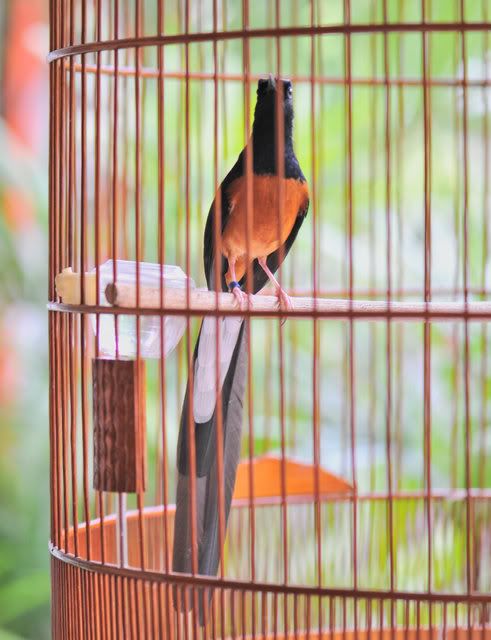
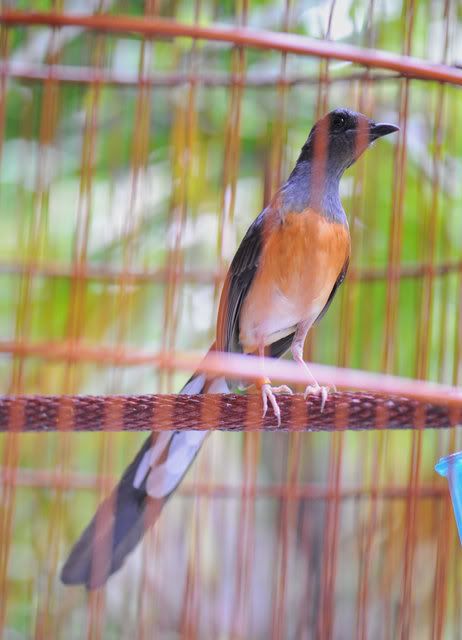
Today I met my friend Reddy. The last time I saw him was when he called at my home to introduce his friend Kevin to me. This was in mid-September last year, shortly after I mentioned on my blog that I had some juvenile shamas for sale. When they visited, the only juvenile that I had in a cage and ready for sale was DDS216. There were 2 other juveniles that I was considering selling but they were still in the aviary. 216 is Icon’s son. Kevin took him.
About a week or so later, I got a call from Reddy who mentioned that he was also interested in taking one of my juveniles. He visited with Kevin on a Saturday when Jeffrey Low was also visiting. I had taken out 2 juveniles from their aviaries in preparation for the visit.
Reddy and Kevin requested Jeffrey and I to assess the 2 juveniles. We both recommended 152 as he had a strong character with eye-catching display, lifting his tails to 90 degrees or more. In comparison with 216, the latter had 6” juvenile tails which were soft and curved. 152’s tails were slightly shorter at 5.75” and also a little stiffer.
I said between 152 and the other juvenile, I preferred 152 for its better display and stronger character. Jeffrey also thought so. Regarding the tail lengths, I said that Reddy should not bother too much about the difference between 216 and 152 as a juvenile male with tails of about 5.75” that I had given to my friend William in 2007 had had 12½” tails after its first molt from juvenile. Jeffrey added that he himself was not much concerned about getting the juvenile with the longest tails as he would think that even the juveniles with the shortest tails could be expected to have tails of at least 10” after the first molt. He noted that he had earlier chosen DDS207 although his juvenile tails were only 4½”. Reddy took 152.
Reddy told me today that Kevin and he are both extremely pleased with their birds. 216 has completed his molt. As expected he has long, soft, curved tails which are about 13” to 13½”. This is exceptionally long for a first molt and the tails may eventually well be more than 16” after the third molt. In his first outing to a shama gathering recently, he had sung and displayed and Kevin had received an unsolicited offer for him that was about 70% more than the price he had paid. Kevin was not interested in selling. I am sure he could obtain a much better price if he wants to part with 216.
Reddy’s 152 is still molting. His tails are presently about 3”. Reddy says that he is very aggressive even during the molt and tends to display along the perch when he hears Reddy’s other shama singing even though it is out of sight. I cautioned that 152 should be kept isolated from other shamas during the molt. Reddy assured that he was doing this and that his other shama was some distance away from 152.
I am often asked questions about tail length. It usually takes the form of “If my juvenile’s tails are xxx” long, how long are they likely to be after the first molt?” It’s almost impossible to tell with wild-caught birds. For instance, a wild-caught juvenile with tails of 5.75” that I bought turned out to have only 7” tails after the first molt. For captive-bred birds which have (amongst other features) been selectively bred for long tails, it is much easier to predict potential tail length. For example, Jeffrey’s DDS207 recently completed its first molt and its replacement tails are about 11” whereas its juvenile tails were only 4½”.
I would like to end by apologizing to those who have written to me recently with requests to purchase my birds and who have not received a reply from me. I thank you for your interest and regret that I presently have no birds for sale. I will keep your contact numbers and let you know if I have anything available in future.
About a week or so later, I got a call from Reddy who mentioned that he was also interested in taking one of my juveniles. He visited with Kevin on a Saturday when Jeffrey Low was also visiting. I had taken out 2 juveniles from their aviaries in preparation for the visit.
Reddy and Kevin requested Jeffrey and I to assess the 2 juveniles. We both recommended 152 as he had a strong character with eye-catching display, lifting his tails to 90 degrees or more. In comparison with 216, the latter had 6” juvenile tails which were soft and curved. 152’s tails were slightly shorter at 5.75” and also a little stiffer.
I said between 152 and the other juvenile, I preferred 152 for its better display and stronger character. Jeffrey also thought so. Regarding the tail lengths, I said that Reddy should not bother too much about the difference between 216 and 152 as a juvenile male with tails of about 5.75” that I had given to my friend William in 2007 had had 12½” tails after its first molt from juvenile. Jeffrey added that he himself was not much concerned about getting the juvenile with the longest tails as he would think that even the juveniles with the shortest tails could be expected to have tails of at least 10” after the first molt. He noted that he had earlier chosen DDS207 although his juvenile tails were only 4½”. Reddy took 152.
Reddy told me today that Kevin and he are both extremely pleased with their birds. 216 has completed his molt. As expected he has long, soft, curved tails which are about 13” to 13½”. This is exceptionally long for a first molt and the tails may eventually well be more than 16” after the third molt. In his first outing to a shama gathering recently, he had sung and displayed and Kevin had received an unsolicited offer for him that was about 70% more than the price he had paid. Kevin was not interested in selling. I am sure he could obtain a much better price if he wants to part with 216.
Reddy’s 152 is still molting. His tails are presently about 3”. Reddy says that he is very aggressive even during the molt and tends to display along the perch when he hears Reddy’s other shama singing even though it is out of sight. I cautioned that 152 should be kept isolated from other shamas during the molt. Reddy assured that he was doing this and that his other shama was some distance away from 152.
I am often asked questions about tail length. It usually takes the form of “If my juvenile’s tails are xxx” long, how long are they likely to be after the first molt?” It’s almost impossible to tell with wild-caught birds. For instance, a wild-caught juvenile with tails of 5.75” that I bought turned out to have only 7” tails after the first molt. For captive-bred birds which have (amongst other features) been selectively bred for long tails, it is much easier to predict potential tail length. For example, Jeffrey’s DDS207 recently completed its first molt and its replacement tails are about 11” whereas its juvenile tails were only 4½”.
I would like to end by apologizing to those who have written to me recently with requests to purchase my birds and who have not received a reply from me. I thank you for your interest and regret that I presently have no birds for sale. I will keep your contact numbers and let you know if I have anything available in future.
Monday, November 3, 2008
Update of 2008 Breeding Season
Monday 3rd November 2008
Yesterday was a busy day. My close friend and I have been formulating a dry food for our shamas and yesterday morning we had an ongoing assessment of the results with consideration of possible other ingredients and methods of preparation.
As recently mentioned, I had decided to stop breeding shamas for this year. However, my close friend is highly impressed with the character of Cochise and wanted to have an offspring from his mother. I therefore paired her to Legend yesterday. The birds took to each other immediately. The female is ready to nest and I expect her to commence nest-building today or within the next day or so. As the pairing is solely to provide a male offspring for my friend, I expect to take only one nest from her before separating the pair.
Michael decided to breed Super Model and the female was paired with him yesterday evening.
Those who acquired Icon's chicks from this year have much to look forward to based on the results of last year. At least one of the chicks from last year now has tails of 17" or more. The offspring last year with the shortest tails (10.25"), now has tails of about 12" after the second moult from juvenile. Icon's chicks also have strong character and very good display.
Yesterday was a busy day. My close friend and I have been formulating a dry food for our shamas and yesterday morning we had an ongoing assessment of the results with consideration of possible other ingredients and methods of preparation.
As recently mentioned, I had decided to stop breeding shamas for this year. However, my close friend is highly impressed with the character of Cochise and wanted to have an offspring from his mother. I therefore paired her to Legend yesterday. The birds took to each other immediately. The female is ready to nest and I expect her to commence nest-building today or within the next day or so. As the pairing is solely to provide a male offspring for my friend, I expect to take only one nest from her before separating the pair.
Michael decided to breed Super Model and the female was paired with him yesterday evening.
Those who acquired Icon's chicks from this year have much to look forward to based on the results of last year. At least one of the chicks from last year now has tails of 17" or more. The offspring last year with the shortest tails (10.25"), now has tails of about 12" after the second moult from juvenile. Icon's chicks also have strong character and very good display.


Monday, June 30, 2008
Genetics
I believe that no matter how much we may know about genetics and line breeding, the production of an outstanding bird or animal is really due to luck. I am grateful that I have been lucky with my breeding of shamas.
This year is an exciting one for me. I have repeat matings of pairs (such as the parents of Pretty Boy and the parents of Longbow) that have already and consistently produced outstanding birds. If they do produce progeny of the quality previously produced I will be more than happy. However, there is always the hope that a Sport, i.e a male that I have only seen in my dreams, will be produced.
I also have proven studs such as Godfather and Legend that I have mated this year to females that I have not tried with them and I am anxious to see what will come out. In addition, there are the matings of birds that have not been previously mated. The anticipation here is of a different kind. We have no idea of what is likely to be produced. Its like throwing a fishing line into the sea in a location where we know we may catch the fish of our dreams. Perhaps we will but we have to wait and see.
My birds are already breeding true for long tails, thin feathers and the type of structure that I want. I don't give much thought at this time to further improving these aspects. There are other aspects to which I am now paying attention. Many have told me that the character, display and song of my birds are better than anything they have come across. This may be but the enjoyment of a hobby requires that there is always some aspect of the bird or animal that we think can be improved. I think the aspects I have mentioned can be further improved and I am concentrating on them this year and in the near future.
This year, I have available for stud a long tailed wild-caught shama from William Kwa that has a dominant character and really outstanding display. He has been mated to one of my female shamas in an out-cross. I will see what he produces. If his progeny show promise, I will add them to my pool of breeding stock. To improve the song, I am looking for an outstanding songster to mate to one of my females. It may take some time, but I and my friends know the sources that may have such a bird and with time, I am sure I will find a suitable specimen.
After I have managed to breed true those aspects of my birds that I think need attention, I will revert to the minor things. For instance, the 2 secondary tails of my males are now often over 8". I think this is a little long and I prefer slightly shorter secondary tails, say about 6" or so. The shorter tails will enable the long primary tails to move with less restraint during the display. The freer movement of the tails will slightly improve the display. And so it goes on - I expect I will be able to find some aspect to improve upon over many many years so that the hobby will always be interesting and each new breeding season will be something to look forward to.
This year is an exciting one for me. I have repeat matings of pairs (such as the parents of Pretty Boy and the parents of Longbow) that have already and consistently produced outstanding birds. If they do produce progeny of the quality previously produced I will be more than happy. However, there is always the hope that a Sport, i.e a male that I have only seen in my dreams, will be produced.
I also have proven studs such as Godfather and Legend that I have mated this year to females that I have not tried with them and I am anxious to see what will come out. In addition, there are the matings of birds that have not been previously mated. The anticipation here is of a different kind. We have no idea of what is likely to be produced. Its like throwing a fishing line into the sea in a location where we know we may catch the fish of our dreams. Perhaps we will but we have to wait and see.
My birds are already breeding true for long tails, thin feathers and the type of structure that I want. I don't give much thought at this time to further improving these aspects. There are other aspects to which I am now paying attention. Many have told me that the character, display and song of my birds are better than anything they have come across. This may be but the enjoyment of a hobby requires that there is always some aspect of the bird or animal that we think can be improved. I think the aspects I have mentioned can be further improved and I am concentrating on them this year and in the near future.
This year, I have available for stud a long tailed wild-caught shama from William Kwa that has a dominant character and really outstanding display. He has been mated to one of my female shamas in an out-cross. I will see what he produces. If his progeny show promise, I will add them to my pool of breeding stock. To improve the song, I am looking for an outstanding songster to mate to one of my females. It may take some time, but I and my friends know the sources that may have such a bird and with time, I am sure I will find a suitable specimen.
After I have managed to breed true those aspects of my birds that I think need attention, I will revert to the minor things. For instance, the 2 secondary tails of my males are now often over 8". I think this is a little long and I prefer slightly shorter secondary tails, say about 6" or so. The shorter tails will enable the long primary tails to move with less restraint during the display. The freer movement of the tails will slightly improve the display. And so it goes on - I expect I will be able to find some aspect to improve upon over many many years so that the hobby will always be interesting and each new breeding season will be something to look forward to.
Friday, June 6, 2008
Icon's First Nest of 2008
Originally posted on April 29, 2008
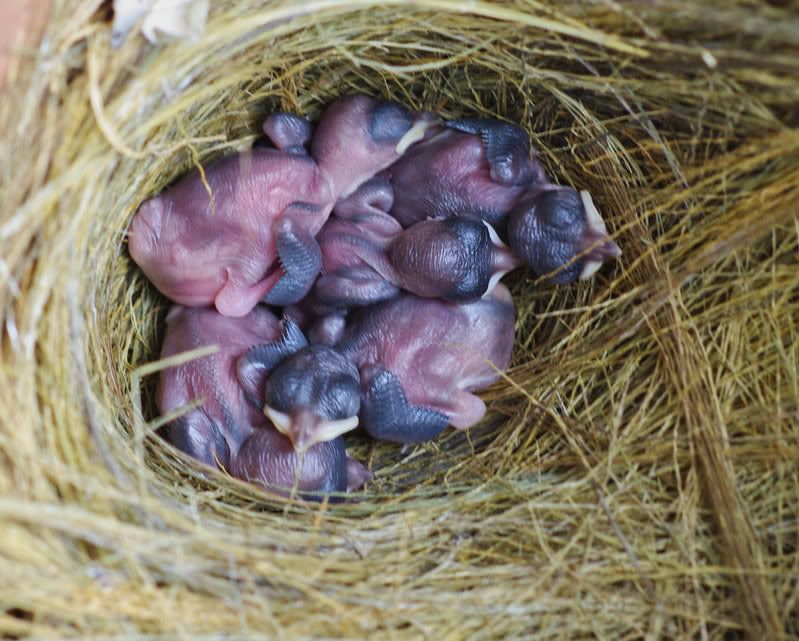
These are Icon's chicks at less than 2 1/2 days old.
Last year, I took 12 chicks from the parents of which 6 were male. The males included Longbow, Fireworks and Max. The tail lengths of 3 of the males after the first molt from juvenile were 10 1/4", 11", 11 1/4" with the remaining 3 chicks having tails exceeding 13". All the chicks are worth having but Longbow, with 11 1/4" tails, arguably can compete with Pretty Boy as the bset male I have ever bred.
I repeated the mating this year. The parents are feeding the chicks. As all the 5 chicks are about the same size and look happy and well fed, it can be seen that the parents are doing a wonderful job.
The mother laid 6 eggs of which 5 hatched. The female will usually lay 3 to 4 eggs and commence to brood when the penultimate egg is laid. When this happens, the last egg will hatch a day later and the chick will have less chance of surviving.
After the 3rd egg the mother did not sit and I was already happy. I expected her to sit upon laying the 4th egg but she did not so I knew there would be a 5th egg. She entered the box on the 5th morning and I was sure there was another egg but again she did not sit. She only commenced to brood after laying the 6th egg. The result is that all the 5 eggs hatched within the same day.
The 11th day after the mother commenced brooding was last Sunday. I was home for most of the day. I counted 2 half eggshells in the morning and another 1/2 eggshell in the afternoon. These eggshells were from the broader part of the egg and tell that at least 3 chicks had hatched. There could be more as the parents may have eaten the eggshells of the other eggs so that no eggshell can be seen.
The parents were attentively going up to the box with food in their beaks so many times that I felt sure there were 4 or more chicks.
I was anxious to know if the chicks were OK so I checked this evening and found 5 chicks. I have successfully had 5 chicks from a nest before. One of these days perhaps I will get 6 chicks from 6 eggs.
I should note that I usually do not check the nest as to do so may upset the parents and result in them abandoning the chicks. However, this pair is used to me and they did not mind me quickly checking and returning the box after photographing the chicks.
These are Icon's chicks at less than 2 1/2 days old.
Last year, I took 12 chicks from the parents of which 6 were male. The males included Longbow, Fireworks and Max. The tail lengths of 3 of the males after the first molt from juvenile were 10 1/4", 11", 11 1/4" with the remaining 3 chicks having tails exceeding 13". All the chicks are worth having but Longbow, with 11 1/4" tails, arguably can compete with Pretty Boy as the bset male I have ever bred.
I repeated the mating this year. The parents are feeding the chicks. As all the 5 chicks are about the same size and look happy and well fed, it can be seen that the parents are doing a wonderful job.
The mother laid 6 eggs of which 5 hatched. The female will usually lay 3 to 4 eggs and commence to brood when the penultimate egg is laid. When this happens, the last egg will hatch a day later and the chick will have less chance of surviving.
After the 3rd egg the mother did not sit and I was already happy. I expected her to sit upon laying the 4th egg but she did not so I knew there would be a 5th egg. She entered the box on the 5th morning and I was sure there was another egg but again she did not sit. She only commenced to brood after laying the 6th egg. The result is that all the 5 eggs hatched within the same day.
The 11th day after the mother commenced brooding was last Sunday. I was home for most of the day. I counted 2 half eggshells in the morning and another 1/2 eggshell in the afternoon. These eggshells were from the broader part of the egg and tell that at least 3 chicks had hatched. There could be more as the parents may have eaten the eggshells of the other eggs so that no eggshell can be seen.
The parents were attentively going up to the box with food in their beaks so many times that I felt sure there were 4 or more chicks.
I was anxious to know if the chicks were OK so I checked this evening and found 5 chicks. I have successfully had 5 chicks from a nest before. One of these days perhaps I will get 6 chicks from 6 eggs.
I should note that I usually do not check the nest as to do so may upset the parents and result in them abandoning the chicks. However, this pair is used to me and they did not mind me quickly checking and returning the box after photographing the chicks.
Start of 2008 Breeding Season
Originally posted April 23, 2008
Hi Jeff,
I believe that no matter how much we may know about genetics and line breeding, the production of an outstanding bird or animal is really due to luck. I am grateful that I have been lucky with my breeding of shamas.
This year is an exciting one for me. I have repeat matings of pairs (such as the parents of Pretty Boy and the parents of Longbow) that have already and consistently produced outstanding birds. If they do produce progeny of the quality previously produced I will be more than happy. However, there is always the hope that a Sport, i.e a male that I have only seen in my dreams, will be produced.
I also have proven studs such as Godfather and Legend that I have mated this year to females that I have not tried with them and I am anxious to see what will come out. In addition, there are the matings of birds that have not been previously mated. The anticipation here is of a different kind. We have no idea of what is likely to be produced. Its like throwing a fishing line into the sea in a location where we know we may catch the fish of our dreams. Perhaps we will but we have to wait and see.
My birds are already breeding true for long tails, thin feathers and the type of structure that I want. I don't give much thought at this time to further improving these aspects. There are other aspects to which I am now paying attention.
Many have told me that the character, display and song of my birds are better than anything they have come across. This may be but the enjoyment of a hobby requires that there is always some aspect of the bird or animal that we think can be improved. I think the aspects I have mentioned can be further improved and I am concentrating on them this year and in the near future.
This year, I have available for stud a long tailed wild-caught shama from William Kwa that has a dominant character and really outstanding display. He has been mated to one of my female shamas in an out-cross. I will see what he produces. If his progeny show promise, I will add them to my pool of breeding stock.
To improve the song, I am looking for an outstanding songster to mate to one of my females. It may take some time, but I and my friends know the sources that may have such a bird and with time, I am sure I will find a suitable specimen.
After I have managed to breed true those aspects of my birds that I think need attention, I will revert to the minor things. For instance, the 2 secondary tails of my males are now often over 8". I think this is a little long and I prefer slightly shorter secondary tails, say about 6" or so. The shorter tails will enable the long primary tails to move with less restraint during the display. The freer movement of the tails will slightly improve the display. And so it goes on - I expect I will be able to find some aspect to improve upon over many many years so that the hobby will always be interesting and each new breeding season will be something to look forward to.
Best regards,
David
Hi Jeff,
I believe that no matter how much we may know about genetics and line breeding, the production of an outstanding bird or animal is really due to luck. I am grateful that I have been lucky with my breeding of shamas.
This year is an exciting one for me. I have repeat matings of pairs (such as the parents of Pretty Boy and the parents of Longbow) that have already and consistently produced outstanding birds. If they do produce progeny of the quality previously produced I will be more than happy. However, there is always the hope that a Sport, i.e a male that I have only seen in my dreams, will be produced.
I also have proven studs such as Godfather and Legend that I have mated this year to females that I have not tried with them and I am anxious to see what will come out. In addition, there are the matings of birds that have not been previously mated. The anticipation here is of a different kind. We have no idea of what is likely to be produced. Its like throwing a fishing line into the sea in a location where we know we may catch the fish of our dreams. Perhaps we will but we have to wait and see.
My birds are already breeding true for long tails, thin feathers and the type of structure that I want. I don't give much thought at this time to further improving these aspects. There are other aspects to which I am now paying attention.
Many have told me that the character, display and song of my birds are better than anything they have come across. This may be but the enjoyment of a hobby requires that there is always some aspect of the bird or animal that we think can be improved. I think the aspects I have mentioned can be further improved and I am concentrating on them this year and in the near future.
This year, I have available for stud a long tailed wild-caught shama from William Kwa that has a dominant character and really outstanding display. He has been mated to one of my female shamas in an out-cross. I will see what he produces. If his progeny show promise, I will add them to my pool of breeding stock.
To improve the song, I am looking for an outstanding songster to mate to one of my females. It may take some time, but I and my friends know the sources that may have such a bird and with time, I am sure I will find a suitable specimen.
After I have managed to breed true those aspects of my birds that I think need attention, I will revert to the minor things. For instance, the 2 secondary tails of my males are now often over 8". I think this is a little long and I prefer slightly shorter secondary tails, say about 6" or so. The shorter tails will enable the long primary tails to move with less restraint during the display. The freer movement of the tails will slightly improve the display. And so it goes on - I expect I will be able to find some aspect to improve upon over many many years so that the hobby will always be interesting and each new breeding season will be something to look forward to.
Best regards,
David
Subscribe to:
Posts (Atom)
