Showing posts with label Medical. Show all posts

Thursday, September 3, 2009

Cataract

On Thu, Sep 3, 2009 at 2:14 AM, juan guillermo alvarez zuluaga wrote:

HELLO MR DAVID,

I AM an amateur keeper of insectivorous birds, especially the White-rumped Shama AND MY INQUIRY CONCERNS THIS BIRD. THE BIRD IS APPROXIMATELY ONE YEAR OF AGE AND PRESENTING THE PROBLEM THAT IN ONE OF ITS EYES IS CATARACT that covers all of it.

At first it was almost not noticeable but now it looks white because of this problem. IF YOU CAN ADVISE ME ON THIS HUGE PROBLEM BECAUSE I would appreciate ME DA MUCHA PENA who became blind.

IS THERE ANY REMEDY OR TREATMENT OR Who can I contact. THANK YOU FOR YOUR ATTENTION AND INTEREST. I congratulate you on your birds that ARE AN INSPIRATION FOR NATURE LOVERS WITH NOT SO MANY YEARS OF EXPERIENCE OF SUCH BIRDS IN THEIR CARE.

SEE YOU SOON AND THANK YOU AGAIN.

ATTE: JUAN GUILLERMO ALVAREZ ZULUAGA
LIVE IN MURCIA-SPAIN


Hi Juan,

I am afraid there that the only reliable cure for cataract is to have an operation to remove the spoilt lens and replace it with an artificial lens. This is routinely done with humans and there have also been successful trials on dogs. As far as I know, it has never been done with birds.

What happens with cataract is that the lens in the eye oxidises and gradually becomes opaque until vision is completely blocked. The effect is somewhat like placing an egg in hot water. The egg-white will turn from clear to white. The process cannot be reversed although there are claims on the internet that this is possible with eye-drops.

Best regards,

David

Friday, December 26, 2008

Deworming Shamas

As those of you who have followed Jeffrey Low's posts on the Malaysian Bird Forum know, he is one of the most knowledgeable keepers of pet birds, including shamas. Certainly, he knows more about the care of shamas and especially their ailments and cures, than I do. His knowledge and experience benefits us all. Below is a short article that I received from him today:

One of my shamas completed its molt three months ago, in September. It molted well. The feathers were glossy and there was no trace of stress lines on the tails. He also had reasonably good form, singing and displaying not only when at home but also at bird gatherings. Somehow, though, he did not reach top form as can be expected after the bird has completed the molt for 1 ½ months or more.

His diet and environment seemed to be fine and did not appear the cause of his inability to reach top form. This suggested to me that he could be harboring intestinal parasites which could have come from the livefood which had been a large part of his diet during the molt.

Two weeks ago, I dosed him with piperazine citrate on 3 occasions 3 during the week. This dewormer is intended only for round worms but it is quite safe to use. There was no subsequent improvement in his condition and I decided to use a broader spectrum dewormer.

I decided on a combination of dewormer, albendazole + praziquantel just in case he has tapeworms etc. I was aware that repeated dosing of albendazole might cause feather damage and it should be avoided especially during the molt. Since he had already completed the molt and since only 1 dose would be required, I felt that it would do no harm. I gave him a carefully calculated dose last week.

Three days after the dose, the two long tails dropped (measured at almost 11 inches ... sigh). So far, nothing else has dropped (even his form remains good). Maybe if I am lucky, there will be no further damage to the new replace tail feathers. Maybe I was right about the presence of worms and the benefits to the bird from their eradication will more than outweigh what is required to regrow the two tail feathers. I can only hope that this doesn't amount to a false molt and instead with the worms gone, the bird will be better off afterwards. Whatever turns out, I don’t intend to use albendazole again to deworm shamas.

Jeffrey Low

Monday, November 10, 2008

Avian Respiratory Diseases

Those who are interested in knowing more about avian respiratory diseases might want to read the article that Jeffrey Low referred me to. It can be found at:

http://www.redrobe.com/sharon/avian-respiratory-diseases.html

Ultimately, if you think one of your birds has a respiratory problem (or any other medical problem) and you are in Singapore, I highly recommend Dr. Hsu Lee Chay of Animal Clinic.

Thursday, October 23, 2008

BrokenWing - 23 October 2008

Broken Wing has continued to recover. His wing has healed completely and he flies as well as before. Here he is "playing the perch" although, as can be seen from the colour of his inner beak, he is not yet in top form. He is fearless notwithstanding his traumatic experience and handling. I am amazed at his spirit.

Thursday, October 9, 2008

Fractured Wing - 7th October 2008, Update

About 7 weeks ago I was surprised to find one of my adult male shamas on the floor of his aviary one morning. He was unable to fly. His right wing hung down. I was at a loss to know what had happened. If a cat, rat or something else had frightened him during the night and he had panicked and hurt himself, it could be expected that there would be feathers all over the place but there was not a single feather on the floor. Also, there was no reason for him to panic, as he would if he was frightened in the dark, as I leave a small light on for my aviary birds.

I caught him and examined his wing. It was fractured. This is what he looked like:
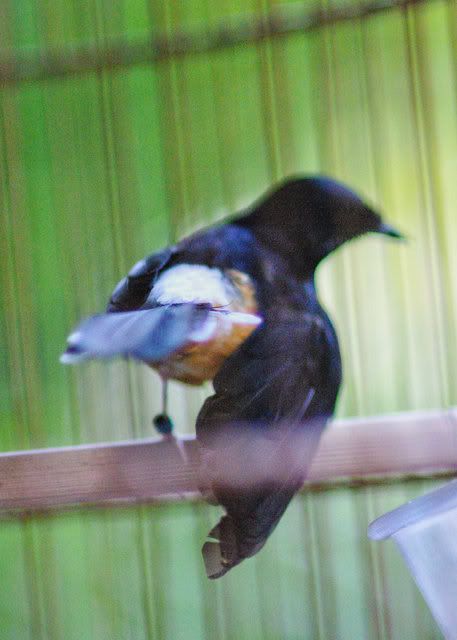

I turned to my first source of consultation, Jeffrey Low. Jeff said that he had never had a bird the size of a shama with a broken wing but if the break was a clean fracture, the wing should be able to heal completely if it was properly bound in place. I agreed to try.

Jeffrey bought surgical tape and with one of us holding the bird, the wing was carefully put in place and then bound tightly to his body. While we were doing this, we marveled at how brave he was. For one thing, his heart was not pounding as would usually be the case with a terrified bird.

After we had bound the wing, we placed him in a small cage to restrict his movement while his wing was healing. The perch and food were placed low so that he could reach them easily. To assist in the healing, I supplemented his food with calcium for bone growth. I also gave additional vitamin E.

The medical books advise that the bandage should be kept in place for 3 to 5 weeks. They caution that immobilizing the wing for too long could result in a atrophy of the wing muscles and the loss of the bird's ability to fly. Nevertheless Jeffrey and I decided to leave the bandage in place for 6 weeks.

Last Sunday was the end of this period and we caught the bird and removed the bandage with a scissors. Whilst we tried to be as gentle as we could, it was inevitable that some of his body and wing feathers would stick to the tape and were removed with it. Eventually, we removed all the tape. Jeff timed the entire process at about half-an-hour. Again, Jeff and I marveled at how brave he was.

Jeff felt the wing and said that the fracture appeared to have healed well. We then returned the bird to his cage. He shook his feathers and appeared none the worst for wear. He did not even seem to have been in stress. He could lift his injured wing for awhile before it drooped. Jeff said that the bird's ability to lift its wing was a good sign as it showed that his wing had healed properly. He also said that and the inability to lift the wing for long was due to the weak wing muscles but with time, it should be fine.

At the time that the bird had the accident, he was part way through his moult. He had completed his body moult but his growing tails were only about 4". I expected the trauma to adversely affect his tail growth and it did. The length of his tails had previously been 13" and it is now fully grown at about 10". This doesn't bother me as his tails should grow to their full length in the next moult.

Within days of the bandage being removed, he had started to sing. It is now slightly more than a week and his condition has improved. He is able to take baths which he enjoys. Also, he is more and more able to lift his wing in place. This is what he looks like today. The photo shows his healed wing. His appearance is a little untidy but this is because some of his feathers were accidentally removed with the surgical tape. He is really a brave bird and I am happy to have him.
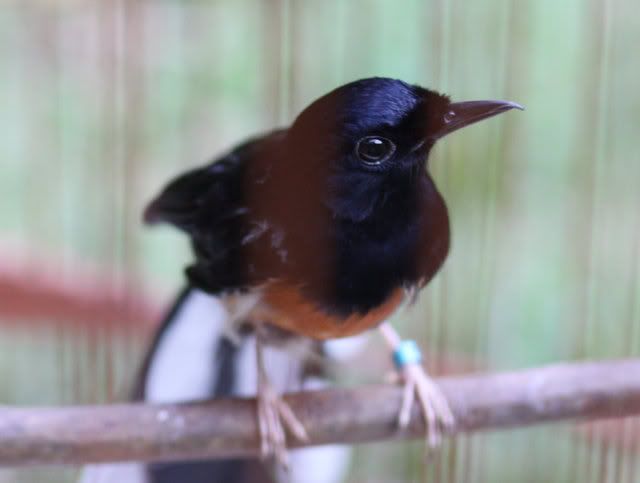

Update - 9th October, 2008

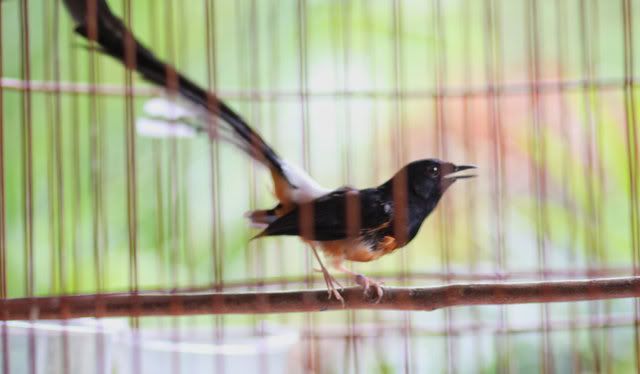
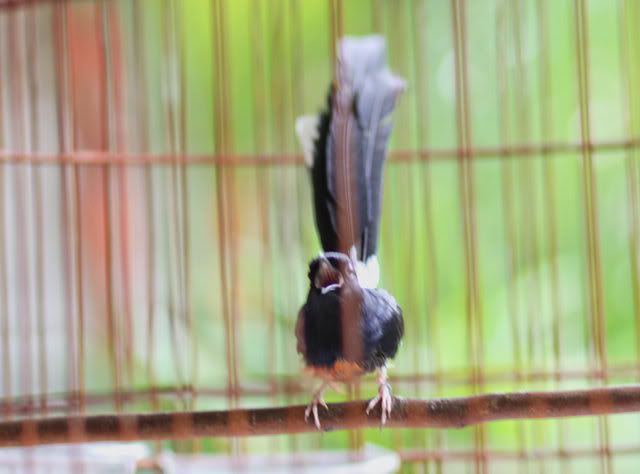
Below are photos I took today of the shama with the fractured wing. Jeffrey Low and I only removed the tight adhesive bandage about 1 1/2 weeks ago. The bird must have suffered severe trauma especially as the process took about 1/2 hour. Yet here he is, already displaying and singing aggressively.

It will be seen that parts of his body feathers are not there. The feathers stuck to the adhesive bandage that bound the fractured wing tight to his body and had to be removed together with the bandage. Although we tried to be as gentle as we could, there was no way the bandage could be removed without also peeling off the feathers.

The wing that fractured was his right wing. As the bird is facing you in the photos, the fractured wing is on your left. The wing looks perfect. The photos help to explain why.

After taking the photos, I released him in my study room and offered him a bathe. He flew normally and seemed to enjoy his flights. Even after taking his bathe and with wet feathers he was able to fly without much effort to a perch which is about 4 feet high. I will let him fully recover his flight muscles in his own time. I think the world of this bird and especially of his courage.



Wednesday, September 3, 2008

Aspergillosis by Jeffrey Low

I sought Jeffrey's opinion recently when one of my shamas developed a cough. It sounds just like a chicken chirping. I took Jeffrey's advice and the cough was cured within a few days. Subsequently, Jeffrey kindly sent me a note on Aspergillosis. I reproduce it below for general information

Commercially prepared shama dry food used in this part of the world most probably includes peanuts and beans in their ingredients. It is important that the moisture content of such food be kept as low as possible. Although most of the commercially available pellet type of dry food are sufficiently low in moisture content, it is wise to pay attention to the storage of these dry food to ensure that they do not absorb too much moisture as well as discarding the dry food in the feeder cups and refreshing them regularly so as to ensure that the birds are not fed with these dry food that could have accumulated moisture for some time.

Beans and peanuts are known to harbour fungi spores and storage of such products requires the moisture content to be sufficiently low in order to prevent these fungi spores from growing and multiplying. Some fungi spores can grow and reproduce in these products with moisture content as low as 13.5%. Raw peanuts are particularly susceptible to Aspergillus molds and are required to be stored below moisture content of below 8% to prevent this.

There are various species of Aspergillus molds and under certain conditions, they can produce a mycotoxin known as aflatoxin which has been known to cause serious human health problems in some parts of the world.. Aflatoxin related problems are very commonly associated with peanuts and corn.

Aspergillosis is a fairly common fungal disease of birds caused by the Aspergillus mold. Symptoms include clicking noise and breathing difficulties. Mortality rate from Aspergillosis is high. One of the causes is due to damp food which encourages the growth and reproduction of the Aspergillus spores.

Monday, August 11, 2008

Swelling and Bubbles On Legs

Question from Canada

My name is Martin and I bought Shamas from Axel a few years ago. I have a question regarding a foot problem. My female has been having this weird swelling on her feet and legs all summer long. it is sometimes red and swollen, sometimes ok. It started on one side but it is now on both sides. She now has a swollen toe with like a bubble on it. The aviary is outdoor and clean so could it be food related? Is there such a thing as too much protein. I feed hard boiled eggs in my mix, do you think she could be getting to much?
Could you suggest me a diet for captivity please? It is a female white rump and my male seems fine.

Many thanks.

Martin Vaillancourt
Niagara. Canada

Answer
Hi Martin,

Your shama is probably suffering from a deficiency of vitamin C. I have not had this problem with my birds but the symptoms you mention are identical to a problem that my good friend Jeffrey Low had. Birds are able to manufacture their vitamin C needs and there is usually no need to supplement with this vitamin. Your bird probably is not able to make enough for her requirements.

Jeffrey's advice is that you give a multi-vitamin and mineral supplement daily for 1 month. Usually if there is a deficiency of one vitamin or mineral there will also be deficiencies of other vitamins and minerals. You will know you are on the right track if the bird gradually recovers. After 1 month, a vitamin and mineral supplement should be given 1 to 3 times a week.

The most effective way to give a substantial dose of the supplement is to inject it into a cricket if a liquid supplement is available. The vitamin and mineral supplemement for humans can be used. I would not be afraid of an overdose at this time. When the bird has recovered, the frequency of feeding and the dosage can be reduced. For normal feeding, I rub a little of the supplement on one or more insects before feeding them to the bird.

Hope the above helps.

Best regards,

David

Friday, June 6, 2008

Fixing Broken Toe Bones by Jeffrey Low (April 2007)

I think the toes of our caged shamas are more commonly involved in mishaps than their other body parts. We sometimes see shamas with missing toes or claws or other defects of the toes, caused by the toes getting caught in the gaps of the doors of cages or some parts of the aviaries. Usually, the front toes are more prone to these accidents. It will be a shame if a good shama's overall posture, movements or its ability to grip is affected by these accidents. The following is written from my limited experience which may be of some use to others.

A toe that got caught in a gap of the cage door or some parts of the aviary could result in a broken toe bone. If the break is severe, it may damage the blood vessels around the area. This will cut off blood supplies to the broken toe and it will gradually turn black from below the point of breakage and this will eventually drop off. Most of the time, the broken toe bone will heal on its own if the blood vessels are not damaged. If the toe bone is left to heal on its own, the toe may end up twisted or crooked and this will affect its grip. Depending on the severity and the direction towards which the toe bone had snapped at the time of breakage, it may be twisted or bent in the same direction when healed. When the breakage occurred too high up the toe (very near to the ‘ankle’) and if at the time of breakage, it had snapped towards the direction of the adjacent toe, it may even end up overlapping or crossing with the adjacent toe, when left to heal on its own. This may also affect the functions of the adjacent toe and its ability to grip. When two toes are affected this way, it will result in the bird suffering from a certain degree of discomfort or pain each time it lands on the perch or on the cage floor.

A freshly broken front toe can be fixed and set to heal perfectly if the blood vessels at the point of breakage are not badly damaged. The broken toe can be super glued to the adjacent good toe. The good toe will act as a splint to prop the broken one and allow it to set (both claws should be clipped short). If it is done well, a freshly broken toe can heal perfectly. A good brand of super glue should be used in order for it to be able to hold the toes together for the period of time to let the broken bone set. Eventually, the glue will wear off and the toes will separate.

In the course of the treatment for the shama with the broken toe, Jeffrey kindly kept me informed of the progress. His emails on the treatment he administered and the problems he encountered are so informative that I thought I would share them with you. I have edited and re-arranged the information so that they are in chronological order.


12th April - Bird was caught and taken out of cage for closer examination of the broken toe. The extreme right front toe (of the right leg) was broken just below the 'wrist'. It had been snapped inwards towards the middle toe at the time of breakage. As a result, it had gone underneath the middle toe and had been stepped on all this time by the middle toe.

The damaged toe had healed to some extent but unfortunately, had also set in such a manner as to cross underneath the middle toe. This also affects the grip of the middle toe. This situation was more difficult than the freshly broken toe bone I had mended for the other shama which I had mentioned to you earlier. The difficulty lies in the fact that this damaged toe had already healed considerably and was set in a crooked and bent position underneath the adjacent good toe.

In order to be assured that the damaged toe is reset to its original position, it will require the toe bone to be broken again as it had already set and had bent underneath the other toe. However, due to my lack of experience in such a delicate procedure, I had decided only to manipulate it into position and super-glued it to the adjacent toe for leverage. The manipulation may cause some damage to the cartilage of the toe bone but it will heal. The use of super glue in my past experience to successfully fix a freshly broken toe bone may not work as well in this case. This is because by propping the bent toe with the adjacent good toe, without breaking the toe bone first, there is a certain amount of force exerted onto the supporting good toe. Will the supporting middle toe be strong enough to prop the bent toe back into position? Will the force exerted from the bent of the damaged toe cause the glue to give way before sufficient time has passed to set it into position? I am keeping my fingers crossed.

13th April – I had taken a day off from work today to observe the bird closely. Bird seems to be unaffected by the ordeal. It was singing its sub-song every now and then and breaks into its loud song occasionally during the day. It had been eating very well too. I had also continued with your feeding regime of live food for the time being and will only convert him to dry food later, after it had healed. Vitamins and calcium will be smeared on the live food every other day. Glucosamine sulfate (aids in repair of cartilage) and methysulfonylmethane (aids in maintaining flexibility and elasticity of joint connective tissues and ligaments) will also be used as supplements during this period.

14th April – Thanks again for the bird you gave me. A long time ago, I succeeded in setting a broken toe bone of a shama to perfect condition. However, that particular bird had a freshly broken toe bone and it was quite easy to reset. I am trying the same with this bird but I am not as confident this time because the bone has been broken for sometime. It is also twisted and has gone underneath another toe and set there. Nevertheless, I am trying to set it back and it is 2 days now since I started doing it.

It looks good so far and the 3 toes are all in the correct place, not overlapping. The bird is very active and that may be a disadvantage at this moment as I am afraid that it will interfere with the healing and growth of the toe bone. I will keep you posted of the outcome. If the positioning of the 3 toes remain for 1 month, than it will probably be permanently ok. It may or may not be perfect but I am hoping for at least a significant improvement.

This particular shama is a very active bird. It will jump up and down the side of the cage speedily (like a puteh). By this morning, it had started to do that and I am beginning to worry that this active nature of his may affect the setting of the toe.

18th April – Close observation revealed that the damaged toe could be causing some pain to the bird as seen in the bird resting only on its left leg and the affected right leg was withdrawn. The frequent jumping up and down the side of the cage was the cause of this. I had observed that during the past few days the damaged toe at this stage was unable to 'grip and release' whenever the bird jumps to the side of the cage. This causes the toe nail of this affected toe to get caught on the cage bars sometimes, as the bird leaves the side of the cage to return to the perch/cage-floor, resulting in pain.

19th April

I would like to share with you some experience I had regarding fixing broken toe bones of birds:

When a toe bone is broken, it may sometimes heal by itself. However, most of the time, the affected toe will be twisted to a greater or lesser extent when left to heal on its own. It really depends on how the bone broke and also towards which direction when it snapped. For example, if at the time of breakage, the toe was snapped towards the left, than if it heals on its own, it will heal with a twist towards the left.

On some occasions, the blood flow to the affected toe may be cut off due to the blood vessels supplying blood to this area being too badly damaged by the breakage. When this happens, the affected toe will turn black after sometime and will eventually drop off.

If a broken toe bone is noticed early, the freshly broken bone can be trained to heal in the correct direction. This is based on the same principle used by bone specialists for humans - by supporting the broken bone and letting it heal on its own. In the case of a bird, it is impossible to use a splint or put a cast around the broken toe bone as support.

What I did in the past was to use super glue to bind the broken toe to the adjacent good toe. The good toe will act as a support during the time of healing. Eventually, the effect of the glue will wear off and the toes will come apart. The tricky part is to have the glue wear off only after the bone has set to a certain extent. A good brand of super glue is Selleys. Those 2 pack epoxy glues should not be used as their bonding strength is too strong.

I caught the bird twice - firstly, to access the damage to the toe and then to treat it.

Damage: The extreme right toe of the right leg was broken at a point close to the 'wrist'. It was also snapped inwards at the time of breakage. It had healed considerably but due to nature of the breakage, it had gone underneath the middle toe. The point of contact between the middle toe and the damaged toe has a blood clot due to pressure and weight constantly being exerted by the middle toe stepping on the damaged toe.

After very careful and close observations, I concluded that if left on its own, the damaged toe may drop off eventually due to the blood supply being restricted by the pressure from the middle toe stepping on it. Also, as the middle toe tries to grip the perch, each time it lands on it, it will be exerting irregular sudden pressures on the damaged toe under it, thereby further restricting a smooth blood flow. The good middle toe itself may also be affected in the long run due to being unable to grip the perch properly.

After weighing the pros and cons, I decided to go ahead with treating the toe. At this moment, the glue is holding well and the setting looks good. The bird is not affected at all by the treatment and is singing and having very good appetite. I am not switching him to dry food yet as I do not want to put any stress on him right now. I put in enough live food in the morning to last the whole day and change fresh ones in the evening when I come home from work. I am not bathing him much at present as the skin on the toes are quite porous and can hold moisture for a while and this will affect the bonding of the glue. Later on, when it is time to let the glues come off, I will start bathing him daily and let the toes soak a little longer.


20th April – Pain seems to be gone and bird is again active. I was contemplating on clipping off at least the hooked part of the toe nail of the damaged toe to minimize the chance of it getting caught at the cage bars again. The bleeding from the quick of the nail, if any, could be easily stopped if I were to do this. The nail will grow back to its normal length later. However, I am very reluctant to have to catch the bird again. We will see how it goes.

30th April – Everything looks good. Part of the glue had worn off and the toes had not crossed back like it was before treatment. I am hoping that the remaining glued areas remain intact until the toe is set. The damaged toe is observed to start gripping the perch. Bird is eating and singing well. It is a very active bird but at this stage, I am wishing that it is not as active.


9th May – Just one day after I had thought that the toe is completely restored to its original position, I was very disappointed today to see that it is closing up on the middle toe, although not crossing underneath it like it was before treatment. Very careful observations had indicated that the bone is not fully set yet and the constant jumping up and down the sides of the cage may have disrupted the healing and setting.

10th May – Regarding the smaller cage, I think even if we were to put him in a smaller cage, he will still jump about but only shorter distance. The problem lies in each time he hits the side of the cage and each time he lands on the cage floor, the impacts will affect the setting of the toe bone. The number of times such impacts occur per day is too much. I had tried covering him up with a cloth but he still jumps about. What do you think if we were to put him back into one of your aviaries during the healing period. Will there be less impact of this nature?

After our phone discussion today, I had re-glued the toes together again. This time, I had applied more glue on the damaged toe to form a cast hoping that this will help to set it better. If need be, nail polish remover (acetone based) can be used to remove this cast later after the toe bone is already well set.

This evening, I spent 3 hours padding the inside of a bath cage with cardboard. Two small areas at the side near to the door were left unpadded to hook on the feeder and water cups. The lower portions of the front and back were left unpadded for better air circulation. The centre of the roof was also padded but the two ends of the roof were left out also for the purpose of air circulation.

With most of the cage padded from the inside, he will have no cage bars to cling to if he tries to jump. The soft cardboard will also protect him from any injuries should he be spooked and tries to bash around in such a small cage.

Someday David, between the two of us, we may even invent a 'straight jacket' to restraint problem birds.

13th May – Your suggestion to transfer the bird to a small and low cage, I think is a brilliant one. This will lessen the impact on the toes caused by the bird jumping down from the side of the tall shama cage to the cage floor. The bird is now in a bath cage. The bath cage is almost fully padded from the inside with cardboards covering up the cage bars to discourage jumping and to provide cushion should the bird be spooked when in such a small and low cage. The perch is only about 2.5 inches from the floor. Some areas on the roof and the lower part of the front and back of the cage was left unpadded to allow for good ventilation.

14th May – All is well so far. The bird can only hop from the perch to the cage floor (2.5 inches) every now and then as there is no cage bars available for him to cling to. I would expect the tail feathers to be damaged from the confinement in this bath cage but that is not a concern at all. As expected, he had stopped singing totally in such an uncomfortable situation. Let's hope that the toe will set well this time. The tail feathers and the form of the bird can be taken care of later during his next molt.

22nd May – All is well this far with the toe treatment. Since the day when you told me that a young bird will re-grow its toe nail, I had been looking out for it and this few days, I had noticed some indication that a new claw is growing from the damaged toe. I hope that I am right. Most important of all is the repositioning of the toes to their original position and I hope this time round, with your advice to use a smaller cage, we will succeed.

26th may – It's been almost half a month since treating the toe for the second time round. I gave him a bath today as I had not taken the risk to bath him so far in case it may interfere with the adhesion of the super glue. There was no harm done after the bath and surprisingly, the slightly damaged primary tail feathers were more or less restored after the bath. They had become slightly twisted and scissors like due to the small cage he is kept in. All the three front toes of the right leg are gripping well and the super glue is still intact. He is already getting quite use to the small cage and is singing loudly in the early mornings before I left for work. I am tempted to put him back to his usual shama cage but I know I will have to resist the temptation for sometime more.

Over last 2 weeks, I had taught him to eat dry food but he is still given lots of live food daily. When would you expect his next molt ? My plans are to give top priority to fixing up the toe. After which, I will convert him to dry food supplemented with live ones. As soon as his next molt is approaching, he will be loaded with live food again. This loading of live food from a diet of dry food come molting time will, I hope, trigger his form.


6th June - By now, I am quite sure that a new claw is growing from the damaged toe. From the look of the toes, it seems like this second treatment to glue the toes together again and to keep him in a small cage had worked very well. I think the toe were already partially set after the first treatment but was not done well enough and this second additional treatment had further strengthened and improved it.

I had looked very closely today and I think most of the glue holding the two toes together is gone although there are some remnants left on other parts of the toes. I don't think the toes will overlap again.