Hello David
Greetings and best wishes from a cold Holland and from a cold Europe.
It’s great to see how Europe, so divided only decades ago, is turning into a loving peaceful community with one currency and one parliament. The last barrier is that we do not as yet have our own European president. Let’s hope for a Hindu Asian woman.
First a rather personal story about last years breeding results. Beauty and Madonna did very well nest after nest, he very sad thing was that I saw Madonna with a coco fibre sticking out of her bill last October I tried to catch her but she outwitted me and a week later she died. Our other couple LT and Eva could not bring their offspring up so I called up a friend Ime who is really a bird whisperer and he managed with your help to bring up two hand reared male shama’s from incubator till grown up. I have kept 2 males from our first nest and a female from the first nest so this year we have three couples. And 2 males for selection.
Another new thing we did was building upbringing cages for the newborn and we now have 9 learning cages for Shama where each young could learn how to sing.
One off the young males turned out to be a fabulous singer - he can even sing two melodies at the same time. I have no knowledge about his brother because he’s the teacher of the two hand reared males of my friend Ime but I expect he’s also a great singer.
As you know Shama lovers in Germany are making a site specially about Shama.
For some reason the Sumatra (tricolor) kind is the most popular in Europe.
There are lots of people I have to disappoint that their beloved birds are not tricolor but in my opinion malapernicus. At that time, and that will surprise you they are disappointed not realising they have they same subspecies you are breeding.
And be realistic 95% wants your birds.
So what I want to say: In Europe there is a tendency growing, to see the different subspecies of Shama and the willingness to keep these subspecies from crossbreeding.
In order to comply that effort we need a true description of these two subspecies.
I made a correct discription, as far as I know, of the tricolor which I would ask you for your comment.
And I would ask you for an description off the malapernicus. I know it’s a hell of a job and maybe not your cup of tea, but who else to ask?
Hallo Thomas.
Leider ist mein Deutsch etwas swierig so mache ich weiter in Englisch.
It’s so much easier and lesser use of a dictionary.
Like you, we, me and my wife love keeping and breeding Shama’s and particularly the tricolor.
Of course I had a close look at your Shama site and noticed a lot of attention goes to the tricolor on your site. Because we made it our goal to breed the best 100% tricolor I may say with some modesty that I’m a bit of an expert considering the tricolor.
There is a lot of misunderstanding about the Sumatra shama and I think I can learn you how to recognize a Sumatra shama not only by it’s looks but also by it’s behaviour.
Why do I think some clarification is needed? That’s because I saw some photo’s on your site with the name Sumatra shama but they are sure not Sumatra’s.
The looks of an Sumatra shama Copsyphus tricolor:
First of all there is no standard Sumatra shama. Sumatra is one of the largest Islands in the world the length North South is more than 2000 km. So it’s understandable there are differences in size and even in song. Nevertheless all shama’s from Sumatra belong to the subspecies Copsychus Tricolor.
For as far as I know there are three types of tricolour. In the South of Sumatra near the Krakatou lives a large type with 12 cm tail length known as the Lampung.
The Lampung is by the locals not very desirable because it’s singing lack’s comparing to the next type the Medan. The Medan lives as the name says in the surrounded aeries of the city of Medan. It’s a bit larger than medium shama size the tail is stiff and 18 till 24 cm in length. This type is highly desirable due to it’s perfect singing ability. In the North of Sumatra lives a smaller type from witch I have no further knowledge. What I do know there is also a tricolor type with a large bill but that is something we still have to find out.
The name tricolor is and should be the first thing to notice and to select the true Sumatra shama. Tricolor is Latin for three colours Black White and the red of the breast. As soon as you see brown or grey in a Shama it’s no tricolor. So If I have a look at the photo’s of your site, Bild 16 sorry but that is for sure no Tricolor also the female’s have only black white and the red of the breast. What they miss is the shine of the feathers.
I have to make one exception for the young females before the second moult they are a bit greyish but they turn into black after second moult. The female as shown on photo 16 is in my opinion from Thailand so probably a malapernicus 17 and 18 are not showing their wings so I can’t say.
19 and 20 nice females but not tricolor I think also malapernicus from Thailand
21 and 22 are Davids birds these are definitely malapernicus that’s the subspecies David breeds. 23 24 and 25 they are showing brown in the wings and the tail fethers are a bit to thin so maybe a cross breed but not 100% tricolor 26 this one could be a tricolor. 27 28 29 and 30 are beautiful examples of the Sumatra Copsyphus tricolor. Medan type
Typical behaviour of the Medan tricolor. The tricolor is in consideration to other Shama subspecies a less aggressive with lesser display. If you have a look at David’s site or they other shama video’s on You tube or on the site of http://pet-cockatiel.com/Dboard/viewforum.php?f=33
The Malayan Shama site you see how these birds show much tail movement.
The Medan tricolor sits much calmer throwing all his energy in his song his song is continuously all year long even during the moult. His song is when he is taught correctly in his first month very diverse and he has a great ability to learn from other birds like the black bird etc. One very special item is that he is able to sing double tones. I even have one young male tricolor named Lodewijk who is able to sing 2 melodies at the same time, you just don’t know what you hear. Another characteristic for The Medan tricolor is his dislike for dry food a Medan tricolor would rather die from hunger before eating something other as insects or little fish or even little mouse. One of my friends succeeded in teaching Medans to eat special dry food but only by taking the mealworms away.
The female Medan tricolor can also sing almost as well as the male - not as loud as his battle song but very beautiful and it’s also one of my objective’s to have a male and female sitting next to each other on the same branch singing together. I have seen this on a video of one of my Indonesian Shama frieds so I know that it’s possible.
The Medan tricolor will have 3 or 4 eggs that she will hatch in 11 days. The chicks will leave the nest after 11 days and than the female will start her next nest in a different place after 4 to 5 days, the male has a very important role by bringing up the young birds while the mother is breeding.
The malapernicnus can lay up to six eggs and begins her next nest after 10 or 12 days.
I’m sure there is a lot more to tell about these beautiful songbirds.
But I hope I helped you in your search for the true tricolour.
Wish you great success with your site
Arjan de Weger
Holland
At last David a video impression of the first Dutch Chai last autum
http://www.youtube.com/watch?v=OCynNm7hMFE
Wish you well
Arjan
Showing posts with label Shama Sub-species. Show all posts
Showing posts with label Shama Sub-species. Show all posts
Thursday, January 22, 2009
Sunday, October 5, 2008
Shamas from Grik & Baling region
First Published September 2006
I think the most desirable shamas are from the area around Grik and Baling. Godfather was supposed to be from there and other birds from these areas have tended to have better character and structure than birds from elsewhere.
I asked the person from whom I got Godfather why his character, structure and display are better than most shamas. I also asked if the other shamas from this area are like him. I give you his answer below though I cannot say how far it is true.
The area around Grik and Baling is very hilly and forested. There is less food on the hills than there is in the lowlands. The result is that each pair needs to occupy and defend a larger territory. On the entire hill, there may be only a pair of shamas as compared to the lowlands where there may be many pairs in an area of similar size. The need to fight for suitable territory makes the Grik and Baling shamas more aggressive with better display and voice. Also, the voice has to be loud since it must carry over a longer distance to define the limits of a larger territory.
As regards structure, the more windy hillside conditions shapes the bird's more streamlined body. There is also less fat as the bird is more active since it has to hunt longer and further for its food. However, the tails tend to be shorter and it is difficult to find a bird with even 9" tails. Godfather is an exception with his 12" tails.
For the past 5 years, I have been looking for a bird from Grik or Baling with at least 11" tails but I have not been successful.
I think the most desirable shamas are from the area around Grik and Baling. Godfather was supposed to be from there and other birds from these areas have tended to have better character and structure than birds from elsewhere.
I asked the person from whom I got Godfather why his character, structure and display are better than most shamas. I also asked if the other shamas from this area are like him. I give you his answer below though I cannot say how far it is true.
The area around Grik and Baling is very hilly and forested. There is less food on the hills than there is in the lowlands. The result is that each pair needs to occupy and defend a larger territory. On the entire hill, there may be only a pair of shamas as compared to the lowlands where there may be many pairs in an area of similar size. The need to fight for suitable territory makes the Grik and Baling shamas more aggressive with better display and voice. Also, the voice has to be loud since it must carry over a longer distance to define the limits of a larger territory.
As regards structure, the more windy hillside conditions shapes the bird's more streamlined body. There is also less fat as the bird is more active since it has to hunt longer and further for its food. However, the tails tend to be shorter and it is difficult to find a bird with even 9" tails. Godfather is an exception with his 12" tails.
For the past 5 years, I have been looking for a bird from Grik or Baling with at least 11" tails but I have not been successful.


Sunday, September 21, 2008
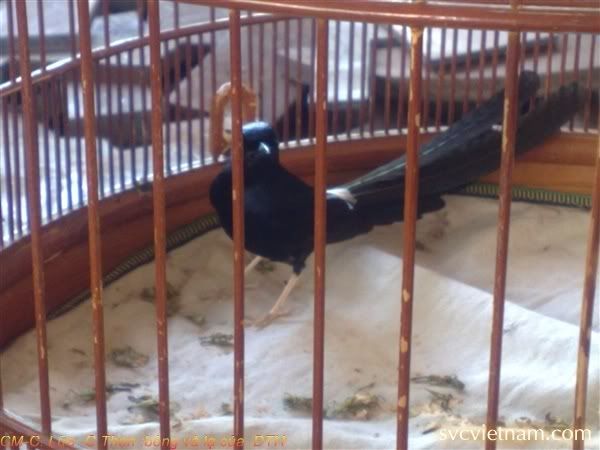
Andy Doan's Black Shama
Hello David, Axel,
As you know I bought the black shama for myself…about 4 months ago……(I had send you the pix before)……it's in Vietnam right now under my uncle's care.
At the moment I have 6 male shamas that were hand-picked for me. One partially albino, one black, all others are normal. The normal ones have tails of at least 9 ½ inches or more from what I was told.
Anyway, I really like to have this black shama so that I can breed it. Would be interesting to see the outcome in a couple of years time. This year, one of my good friends successfully bred a partially albino pair. The male is at least 80 to 85 % white……female about 20 % only. To our surprise all their chicks had lots of white feathers on them.
Here are more pix of the black shama. These are much better than the one I send to you before which had been taken with a cell-phone while the bird before the bird finished its molt .... therefore, not so clear.
Quite nice to see something different once in awhile! I was told its quite aggressive………..with average display. Would perform at any gathering…………but song is just average only. Was told before I bought it….tails of 22 cm………from the pix……….I would guess its 20 cm only.

As you know I bought the black shama for myself…about 4 months ago……(I had send you the pix before)……it's in Vietnam right now under my uncle's care.
At the moment I have 6 male shamas that were hand-picked for me. One partially albino, one black, all others are normal. The normal ones have tails of at least 9 ½ inches or more from what I was told.
Anyway, I really like to have this black shama so that I can breed it. Would be interesting to see the outcome in a couple of years time. This year, one of my good friends successfully bred a partially albino pair. The male is at least 80 to 85 % white……female about 20 % only. To our surprise all their chicks had lots of white feathers on them.
Here are more pix of the black shama. These are much better than the one I send to you before which had been taken with a cell-phone while the bird before the bird finished its molt .... therefore, not so clear.
Quite nice to see something different once in awhile! I was told its quite aggressive………..with average display. Would perform at any gathering…………but song is just average only. Was told before I bought it….tails of 22 cm………from the pix……….I would guess its 20 cm only.
Thursday, July 24, 2008
List of Sub-species
Subspecies and origin of Copsychus malabaricus
C.m. malabaricus (Scopoli) : India
C.m.leggei (Whistler): Ceylon;
C.m. Ïndicus (Baker) : from Nepal along the slpopes of the Himalaya via Sikkim, Bhutan till As-sam, south till Uttar Pradesh and North of Andhra Pradesh;
C.m. albiventris (Blyth): Andamanen-Islands
C.m. interpositus (Robinson & Kloss): Birma, Thailand, Vietnam, Laos, S/A China;
C.m.barbouri (???)Borneo (kalimantan) Maratura
C.m.minor (Swinhoe): Island Hainan;
C.m. mallopercnus (Oberholser): Malakka and the Islands for the coast of South East Sumatra;
C.m. tricolor(Vieillot) : Sumatra, Riau Archipel, Bangka, Billiton,Karimata-eilanden and Java;
C.m. mirabilis Hoogerwerf : Island Panaitan (south of Sunda street);
C.m. melanurus (Salvadori) : The Islands Simeulue, Lasia, Babi, Nias, Siberut en Pagai (all west of Sumatra);
C.m. opisthopelus (Oberholser) : The Islands, Bangkaru, Telo, Tanahmasa, Tanahbala and Banjak (all west of Sumatra);
C.m. opisthisus (???) Metaiwan Islands
C.m. javanus (Kloss) : West- en center-Java;
C.m.omissus (Hartert): EastJava;
C.m. ochroptilus (Oberholser): Anambas-Islands
C.m. eumesus (Oberholser): Natuna-Islands
C.m.suavis ( Sclater): Borneo (Kalimantan) (not in the North);
C.m stricklandi (???) Borneo (Kalimantan) Maratura
C.m.nigricauda (Vorderman): Kangean-Islands and the Island Matasiri (in the Java-Sea).
"C. m. pellogynus (???) ??????
C.m. malabaricus (Scopoli) : India
C.m.leggei (Whistler): Ceylon;
C.m. Ïndicus (Baker) : from Nepal along the slpopes of the Himalaya via Sikkim, Bhutan till As-sam, south till Uttar Pradesh and North of Andhra Pradesh;
C.m. albiventris (Blyth): Andamanen-Islands
C.m. interpositus (Robinson & Kloss): Birma, Thailand, Vietnam, Laos, S/A China;
C.m.barbouri (???)Borneo (kalimantan) Maratura
C.m.minor (Swinhoe): Island Hainan;
C.m. mallopercnus (Oberholser): Malakka and the Islands for the coast of South East Sumatra;
C.m. tricolor(Vieillot) : Sumatra, Riau Archipel, Bangka, Billiton,Karimata-eilanden and Java;
C.m. mirabilis Hoogerwerf : Island Panaitan (south of Sunda street);
C.m. melanurus (Salvadori) : The Islands Simeulue, Lasia, Babi, Nias, Siberut en Pagai (all west of Sumatra);
C.m. opisthopelus (Oberholser) : The Islands, Bangkaru, Telo, Tanahmasa, Tanahbala and Banjak (all west of Sumatra);
C.m. opisthisus (???) Metaiwan Islands
C.m. javanus (Kloss) : West- en center-Java;
C.m.omissus (Hartert): EastJava;
C.m. ochroptilus (Oberholser): Anambas-Islands
C.m. eumesus (Oberholser): Natuna-Islands
C.m.suavis ( Sclater): Borneo (Kalimantan) (not in the North);
C.m stricklandi (???) Borneo (Kalimantan) Maratura
C.m.nigricauda (Vorderman): Kangean-Islands and the Island Matasiri (in the Java-Sea).
"C. m. pellogynus (???) ??????
Tuesday, July 15, 2008
Letter from Yogi
Below is a letter that my friends and I received from Yogi of Indonesia. Yogi has a deep knowledge of the shama species in Indonesia and their care. His many wonderful birds can be seen at his photobucket website: http://i175.photobucket.com/albums/w160/muraiku/. He is also one of the Super Moderators of the Indonesian songbird website www.kicaumania.org. Much can be learnt from him.
From: Prayogi
Sent: Wednesday, February 07, 2007 9:41 AM
To: Axel Voeltz; Shama - David
Cc: Andy Doan
Subject: Re: Emailing: Copsychusmalabaricusleggei2-1
Quote:
Hai How are you ...
Too long I never contact you ... talking about the birds especially Shama. I believe all of you still hobbies with shama like me. I am more crazy with shama until now, I have about 20 shama's at my home. Shama call a Murai Batu in my country, my shama most of from Sumatra, especially
from North Sumatra (Medan). The Shama from Medan area is very famous and the best shama in my country for competition.
Surprised ! but make me worry due to your email. After I was looking for
your topic, I found at "Malaysia Bird Forum" about Post subject:
White-rumped Shama Copsychus malabaricus subspecies by Arjan.
Talking about Shama (White rumped shama) in my country, as general can classification:
1. Shama Sumatra + Include Nias island
2. Shama Java+Bali (Include Kangean island)
3. Kalimantan/Borneo
- Shama from Sumatra island has specific too:
* from North of Jambi to Medan/Aceh --> has specific feature: bigger than others location, long tailed, sharp feather of color , more various song than others
* from South of Jambi south to South of Sumatra (Lampung) --> usually has long tail
* from Borneo kalimantan/Borneo --> has a specific feature: long tailed,
color of feather less sharp than other location, when singing feather of
breast will be inflated.
I don't understand what Arjan's explained at the "Malaysia Bird Forum" ,
beside he got from http://www.orientalbirdimages.org also he might be got from the other web site, make me confused.
* C.m. indicus ---> I think immature or less vitamin or mineral when growing up
* Shama with dots on wings --> female
* Cosychus niger --> female
* The brown tailed Shama --> the same bird, see finger
I have about 20 shama, partly I put at www.photobucket.com/, next time I will put completely, please see my shamas at http://i175.photobucket.com/albums/w160/muraiku/
I can not explained too more ... talking about shama is interesting, sometime every location has characteristic event as general same
color, but cause of situation, environment or due to less vitamins and
mineral the color should be less different.
Bird song hobbies in my country has a group, one of Super Moderator is me please come to our web site just to see picts of shama. Go to Forum "Murai Batu" and I always there. Our web site is www.kicaumania.org.
I am sorry due to my job that way seldom contact you ....
Uncle Voeltz, I see your picture ....
Cheers
Yogi
From: Prayogi
Sent: Wednesday, February 07, 2007 9:41 AM
To: Axel Voeltz; Shama - David
Cc: Andy Doan
Subject: Re: Emailing: Copsychusmalabaricusleggei2-1
Quote:
Hai How are you ...
Too long I never contact you ... talking about the birds especially Shama. I believe all of you still hobbies with shama like me. I am more crazy with shama until now, I have about 20 shama's at my home. Shama call a Murai Batu in my country, my shama most of from Sumatra, especially
from North Sumatra (Medan). The Shama from Medan area is very famous and the best shama in my country for competition.
Surprised ! but make me worry due to your email. After I was looking for
your topic, I found at "Malaysia Bird Forum" about Post subject:
White-rumped Shama Copsychus malabaricus subspecies by Arjan.
Talking about Shama (White rumped shama) in my country, as general can classification:
1. Shama Sumatra + Include Nias island
2. Shama Java+Bali (Include Kangean island)
3. Kalimantan/Borneo
- Shama from Sumatra island has specific too:
* from North of Jambi to Medan/Aceh --> has specific feature: bigger than others location, long tailed, sharp feather of color , more various song than others
* from South of Jambi south to South of Sumatra (Lampung) --> usually has long tail
* from Borneo kalimantan/Borneo --> has a specific feature: long tailed,
color of feather less sharp than other location, when singing feather of
breast will be inflated.
I don't understand what Arjan's explained at the "Malaysia Bird Forum" ,
beside he got from http://www.orientalbirdimages.org also he might be got from the other web site, make me confused.
* C.m. indicus ---> I think immature or less vitamin or mineral when growing up
* Shama with dots on wings --> female
* Cosychus niger --> female
* The brown tailed Shama --> the same bird, see finger
I have about 20 shama, partly I put at www.photobucket.com/, next time I will put completely, please see my shamas at http://i175.photobucket.com/albums/w160/muraiku/
I can not explained too more ... talking about shama is interesting, sometime every location has characteristic event as general same
color, but cause of situation, environment or due to less vitamins and
mineral the color should be less different.
Bird song hobbies in my country has a group, one of Super Moderator is me please come to our web site just to see picts of shama. Go to Forum "Murai Batu" and I always there. Our web site is www.kicaumania.org.
I am sorry due to my job that way seldom contact you ....
Uncle Voeltz, I see your picture ....
Cheers
Yogi
Friday, June 27, 2008
To What Extent Are there Sub-species?
I have never had the interest to try to determine the various possible sub-species of the white-rumped shamas (copsychus malabaricus) in the various regions of Asia. I suspect, that many of the supposed sub-species may not be true sub-species if DNA tests are carried out. As you know a sub-species is generally created because of its geographical isolation. The terrain, climate and availability of food have an effect on the bird's structure, display, agressiveness, song etc so that over a period, slight differences in structure and other features appear in the birds in a particular locality as compared to those in another locality.
However, if the birds from one locality are transferred to another locality, over a period their descendants will tend to seem much like those of the shamas in that locality. An example will more clearly show what I mean. Let's take an Irish family who suffer hard times in their home country and emigrate to the USA as did many others in the late 19th and early 20th century. Over 3 generations or more, their descendants will be exposed to better nutrition and a different cultural mix and we will be able to recognize them as Americans. However, if these same Americans are relocated back to Ireland and exposed to the same conditions their forefathers had experienced, they will likely revert over time to what their forefathers had originally looked and sounded like. In my view, they cannot be considered to be a true "sub-species".
There are of course the true sub-species. These are birds from a particular locality that are clearly distinguishable from the White-rumped Shama. Thus we have the White-crowned shama ("copsychus stricklandii") from Borneo. It is much like its relatives in the south to central parts of Peninsula Malaysia except that there is a white cap on the top of its head. I kept a pair for awhile but did not breed them as I found the song of indifferent quality. There is also the black shama ("copsychus cebuensis"), or siloy from the island of Cebu in the Phillipines. This species is on the CITES endangered list and I have never seen one except in photographs. Then there is the Black-tailed shama from Indonesia. As the name implies, all the 12 tails are black instead of 4 black and 8 white tails. There appear to be 2 sub-species of the Black-tailed Shama. One species has tails of about 4 inches. The males of this species have a very variable song but I felt that the bits could be better strung together to make a more musical whole.
I have seen 3 males at different times of what I think is another sub-species of Black-tailed Shama. These birds had long tails of about 11" and I toyed with the idea of breeding them until their progeny bred true. I did not do so as none of the 3 birds impressed me with their song and I concluded that the type of song was endemic to this race. There are other true sub-species such as the Rufous-tailed Shama ("Copsychus pyrropygus"), where the shama is differentiated from the White-rumped shama by something more than just size, or quality of feathering. These are true sub-species.
I may be wrong but I do not consider a bird to be a distinct sub-species merely because it is say, of a different size from the birds in some other locality. We know that the shamas from a particular locality can be expected to be of a certain type. Thus the shamas from Medan generally have short tails, are thicker feathered and have better songs than those from other regions. If long tailed Indonesian shamas are wanted, these can more likely be found in the province of Acheh than Medan. Again, the shamas from southern Malaysia are more like the shamas from Medan except that the voice is not as good and they tend to be smaller.
We know that the most beautiful long tailed shamas are more likely to be found in Langkawi and its nearby islands along the border of Malaysia and Thailand but the song is not comparable to the Medan shamas and neither is the display as good or the birds as aggressive as the shamas from Grik and Baling in Malaysia. However, even in a particular locality, there are variations in the shamas. Many years ago, shamas from Vietnam were imported in small numbers into Singapore. They were not popular. The birds were small bodied with relatively long narrow tails. More recently, with the opening up of Vietnam to foreigners, Singaporeans have visited shama competitions in Vietnam and been able to buy birds that do well. The birds that have been brought back look very much like the best Malaysian birds. This again shows that the shamas can vary even in a particular locality. Thus, even with the shamas in Medan, there will be found those that look much like the shamas in Malaysia.
The above explains why I have not bothered to study the various sub-species. My aim in breeding shamas is to try, in my small way, to do for the shama what has been done for the canary i.e. to breed White-rumpe Shamas to a type that I consider superior to those available in the wild. With this in mind, I disregard the supposed sub-specie variations amongst the White-rumped Shama and choose as breeding stock the type of shama from any locality that most satisfies the factors that make up the ideal that I have in mind. These include factors relating to structure, feather quality, length of tail, variability and musicality of song, aggressiveness and display. I would like to say something about aggressiveness.
I have seen some comments from Europe that seem to suggest that it may not be a good thing to promote aggressiveness in a shama against other shamas. I think this is wrong. Bear in mind that the shama belongs to that group of birds and animals that has to conquer and defend territory in the wild if it is to successfully mate and pass on its genes. The stronger and more aggressive the shama, the better the territory it will be able to conquer and defend. A shama that is timid will be unable to get a a suitable territory and mate and pass on its genes. I therefore think that we need to retain and improve this trait in our captive breeding program.
However, if the birds from one locality are transferred to another locality, over a period their descendants will tend to seem much like those of the shamas in that locality. An example will more clearly show what I mean. Let's take an Irish family who suffer hard times in their home country and emigrate to the USA as did many others in the late 19th and early 20th century. Over 3 generations or more, their descendants will be exposed to better nutrition and a different cultural mix and we will be able to recognize them as Americans. However, if these same Americans are relocated back to Ireland and exposed to the same conditions their forefathers had experienced, they will likely revert over time to what their forefathers had originally looked and sounded like. In my view, they cannot be considered to be a true "sub-species".
There are of course the true sub-species. These are birds from a particular locality that are clearly distinguishable from the White-rumped Shama. Thus we have the White-crowned shama ("copsychus stricklandii") from Borneo. It is much like its relatives in the south to central parts of Peninsula Malaysia except that there is a white cap on the top of its head. I kept a pair for awhile but did not breed them as I found the song of indifferent quality. There is also the black shama ("copsychus cebuensis"), or siloy from the island of Cebu in the Phillipines. This species is on the CITES endangered list and I have never seen one except in photographs. Then there is the Black-tailed shama from Indonesia. As the name implies, all the 12 tails are black instead of 4 black and 8 white tails. There appear to be 2 sub-species of the Black-tailed Shama. One species has tails of about 4 inches. The males of this species have a very variable song but I felt that the bits could be better strung together to make a more musical whole.
I have seen 3 males at different times of what I think is another sub-species of Black-tailed Shama. These birds had long tails of about 11" and I toyed with the idea of breeding them until their progeny bred true. I did not do so as none of the 3 birds impressed me with their song and I concluded that the type of song was endemic to this race. There are other true sub-species such as the Rufous-tailed Shama ("Copsychus pyrropygus"), where the shama is differentiated from the White-rumped shama by something more than just size, or quality of feathering. These are true sub-species.
I may be wrong but I do not consider a bird to be a distinct sub-species merely because it is say, of a different size from the birds in some other locality. We know that the shamas from a particular locality can be expected to be of a certain type. Thus the shamas from Medan generally have short tails, are thicker feathered and have better songs than those from other regions. If long tailed Indonesian shamas are wanted, these can more likely be found in the province of Acheh than Medan. Again, the shamas from southern Malaysia are more like the shamas from Medan except that the voice is not as good and they tend to be smaller.
We know that the most beautiful long tailed shamas are more likely to be found in Langkawi and its nearby islands along the border of Malaysia and Thailand but the song is not comparable to the Medan shamas and neither is the display as good or the birds as aggressive as the shamas from Grik and Baling in Malaysia. However, even in a particular locality, there are variations in the shamas. Many years ago, shamas from Vietnam were imported in small numbers into Singapore. They were not popular. The birds were small bodied with relatively long narrow tails. More recently, with the opening up of Vietnam to foreigners, Singaporeans have visited shama competitions in Vietnam and been able to buy birds that do well. The birds that have been brought back look very much like the best Malaysian birds. This again shows that the shamas can vary even in a particular locality. Thus, even with the shamas in Medan, there will be found those that look much like the shamas in Malaysia.
The above explains why I have not bothered to study the various sub-species. My aim in breeding shamas is to try, in my small way, to do for the shama what has been done for the canary i.e. to breed White-rumpe Shamas to a type that I consider superior to those available in the wild. With this in mind, I disregard the supposed sub-specie variations amongst the White-rumped Shama and choose as breeding stock the type of shama from any locality that most satisfies the factors that make up the ideal that I have in mind. These include factors relating to structure, feather quality, length of tail, variability and musicality of song, aggressiveness and display. I would like to say something about aggressiveness.
I have seen some comments from Europe that seem to suggest that it may not be a good thing to promote aggressiveness in a shama against other shamas. I think this is wrong. Bear in mind that the shama belongs to that group of birds and animals that has to conquer and defend territory in the wild if it is to successfully mate and pass on its genes. The stronger and more aggressive the shama, the better the territory it will be able to conquer and defend. A shama that is timid will be unable to get a a suitable territory and mate and pass on its genes. I therefore think that we need to retain and improve this trait in our captive breeding program.
Subscribe to:
Posts (Atom)
