Showing posts with label Juvenile Shamas. Show all posts

Monday, March 2, 2015

Weekend update


Drumbeat in competition

Falcon's 8 months' old son, Drumbeat, was champion at yesterday's Kebun Baru Bird Club shama competition at AMK159, Singapore. Almost 90 shamas competed.  This is about the maximum number of entries for a shama competition in Singapore.


Male shamas come into their prime at about 4 years of age.  This is when they are fully mature and physically and sexually at their peak and able to conquer and defend territory. As a rule therefore, I do not like to compete first molt shamas that are only a few months old, such as Drumbeat. It's like putting a teenager in the boxing ring with a professional adult.

There was a good reason for breaking this rule in Drumbeat's case. I had bred his father, Falcon, for the first time last year when he had produced 6 males.  They all had the structure that I have come to expect from my line of birds.  While there was varying tail length on completion of their first molt, the variance was from 10 3/4" to 13" which is normal. The offspring with the longest first molt tails was Nighthawk.

Being satisfied with Falcon's ability to produce offspring of desirable structure, tail length, soft feathering, display and song, it only remained to assess and confirm the extent of the courage and endurance of his offspring from last year. By assessing his progeny, I would be able to confirm that Falcon is capable of producing offspring of the type produced by Apache, Skyhawk, Pretty Boy and my other shamas, i.e with strong character and display, that can perform exceptionally well in any gathering of shamas. The best way to ascertain this, was to test the courage and endurance of one of Falcon's sons in a competition.  I chose Drumbeat as he had completed his molt and was in form. I already knew that he had courage from his performances in small groups of shamas, such as at Michael's home, but the competition would fully test and confirm the extent of his courage and endurance in a large gathering of shamas.

Drumbeat has a characteristic that is not often found in shamas and which is something that I desire to breed true in my line of birds. Most shamas (naturally) tend to be stressed by unusual new experiences and need time to adjust before they can perform. For example, they tend not to sing and display well the first few times they are transported in a vehicle.

With Drumbeat, though, he seemed to enjoy his outings from a very young age.  On his very first transportation in a car, he was quiet and relaxed during the trip and able to perform immediately at the end of the journey. He reminded me of shamas with super strong characters such as Apache's sons, Cochise, Piston and Funkie, and some other shamas I have known.

Drumbeat's ability to remain unstressed stood him in good stead in the competition yesterday.  I arrived late, just as instructions were being issued for the cage covers to be removed for the start of the competitiion. Consequently, his cage cover had to be removed before he could be given time to recover from the journey. This was undesirable especially as it was Drumbeat's very first competition.  Actually, before this, he had not even been brought to a shama gathering (chai tio) and his training outside the home had comprised mainly of getting him used to people and testing him in small groups of 2 to 4 shamas. There was no need to be concerned. Drumbeat performed immediately the cage cover was removed.

Yesterday's competition was organised in the same manner as most competitions in Singapore nowadays.  There were 3 preliminary rounds of half an hour each and a final round of another 1/2 hour.  Between the preliminary rounds and the final round there was a wait of about 1/2 hour whilst the points were tallied to obtain the average marks of the 3 judges (who had assessed 30 birds each in rotation) in the preliminary rounds.  The top 30 shamas (out of 90) are chosen for the final round which is scored by 2 judges who assess 15 birds each in rotation and the marks are then added and averaged.

Very young shamas, even those with strong character, seldom do well in a competition where there is a final round as they tend to lack the endurance of shamas in their prime.  I was therefore pleased at Drumbeat's performance over the 4 rounds.  He confirmed my faith in him and in Falcon as a producer of outstanding shamas. To maximise the offspring from Falcon, I will be breeding him "polygamously". I hope to write on this topic at some future date.

Sting

Sting is completing his 3rd molt and I transferred him from aviary to cage yesterday.  He has had a very good molt and is already coming into form as can be seen from the video below.

I have not decided if I will breed or compete him this year.

Wednesday, July 16, 2014

Captive-bred male shama chicks at 20 days of age


Wednesday, June 29, 2011

Photobucket

Photobucket

Photobucket

Monday, June 27, 2011

Weekend iphone photos of 2 months old captive-bred juveniles


Constant attention to improving the character, structure and song of my captive-bred shamas has led to what is likely to be the most promising crop of youngsters this year than I have bred over the years.  My friends who have seen my birds and the results of my breeding program over the years also share this view.


Photobucket


Breeding brings with it the excitement and hope each year of producing that one in a million shama.

Weekends and spare time during the breeding season are enjoyably spent placing the taimong cages together and assessing the birds as I and my friends try to see if there is a special bird and if we can spot it.


Photobucket


However, nothing is certain with juveniles and what appears ordinary one day may turn out to be the special one on another occasion, perhaps after the molt.  That's why I and other serious breeders are so reluctant to part with our juveniles.


PhotobucketPhotobucket

Photobucket

The accompanying photos are the result of assessing some juveniles over the weekend.  They added interest to the morning as we passed our time with each person having his personal favourite and exchanging comments over which of the birds is "better" than the others.

The birds look a little scruffy as the body molt has commenced but it may be a month or more before they shed their tails.


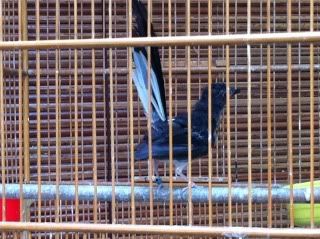
For me, I like the juvenile in the 1st, 2nd, 4th, 5th and last photo.  As can be seen, he is showy and I took more pictures of him than of his 2 brothers as he tended to pose more readily than them. He shows attitude and if I eventually decide to keep him, I may name him, "Boss".


This is not to say that his 2 brothers are not as "good" as him.  It is just that at the weekend, he looked the most promising to me but it may be different next week or in months when his brothers or others may outshine him.

In fact, on Saturday evening, I took along his brother when Jeffrey, Alan and I visited Dr. Sun's home where he had an informal gathering of some shama friends.  


Photobucket
Photobucket
His brother looked really good at Dr. Sun's home and received many favourable comments (6th, 9th and 10th photo). The third juvenile is in photos 3rd, 7th and 8th.  I was not able to fully catch his display and the best I could do is what you see in photo no. 8.  However, as commented by Jeffrey, "he lifts his tails until they hit his head".

I had caught the birds with a net from their aviary only the day before and they had not had time to settle.  I expect there will be more enjoyable weekends when we reconsider our choices and wait impatiently for the juveniles to complete their molt.


Photobucket

Photobucket


Photobucket

Friday, May 20, 2011

Alan's Shamas(2)

I understand that Alan has had overwhelming response for his taimongs.  There were 4 taimongs and 3 went to new homes yesterday morning.  The last taimong is the one below.  This photo and 2 additional photos of it are on Alan's blog: http://whiterumpshamacollections.blogspot.com/

No comment need be made on the remaining taimong as the picture speaks for itself.  I think he has decided to keep it.


BTW I had a phone call from a friend yesterday that there were 2 first molt wild-caught shamas available for sale in Singapore.  One was supposed to have a tail-length of 12" and the other 11".  The prices were S$3,500.00 and S$3,000.00 respectively.  I was also informed that their primary tails had shed recently but I could view the old tails.  I knew the seller and he could be relied on if he said that the shed tails were formerly on the birds.

The prices seemed reasonable.  I was interested and went after work to view the birds. Both did not have form so their structures and characters could not be assessed.  The lack of form is not surprising as the birds were molting and their main diet was dried food.

I asked to see the tails and they were produced.  One set was 9" and the other was 9 1/2" .  The seller clarified that it was their fathers (and not them) that had tails of 11" and 12" so my friend who phoned me must have had mufflers covering his ears or he needs to see a ear doctor.  I didn't mind making the trip, though, as I am happy to view shamas that may be of interest.

Wow, I thought, the prices of shamas in Singapore have really shot through the roof but there must be demand since this particular seller used to charge about half the sum for similar birds not so long ago.

All in all, taking into consideration the length of tails etc, the 2 birds were not what I was looking for to add to the gene pool of my birds and I made no offer for them.

Wednesday, June 17, 2009

Juvenile Shamas

The shama is a unique songbird with an unrivalled combination of infinitely variable and musical song, a beautiful combination of contrasting colours, and (in the most desirable males) exquisite long tails and a truly amazing display.

Juveniles (referred to in Singapore and Malaysia as "taimongs") will not have developed the adult's colours, full song and display but indications of what the juvenile will be as an adult into may be visible.

Below is a video of DDS239. He is the offspring of Apache and Super Model's Daughter. He was bred by me and is now owned by Jeffrey Low. A feature of his display is a unique ability to fan out his white tail feathers. His display in the video indicates that he will be an aggressive and dominant male when he matures. From my past experience with shamas from my breeding, his relatively long juvenile tails suggests that he will have adult tails exceeding 12".

Thursday, July 17, 2008

Taimongs: Tail Length

A note on taimongs

Be aware that an unscrupulous seller of taimongs may pull out the taimong's primary or long tails knowing that when the new or adult tails grow they will always be longer than the taimong's tails. The inexperienced buyer sees a taimong say, with 7" tails, and he buys the bird as he thinks he is getting a fantastic buy. He expects substantially longer tails when his bird molts and receives an unpleasant surprise when he finds that the tails after the molt are about the same length as those that his taimong had.

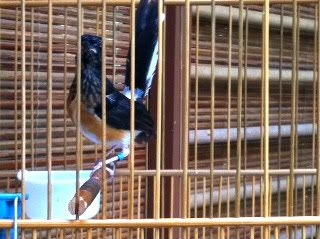
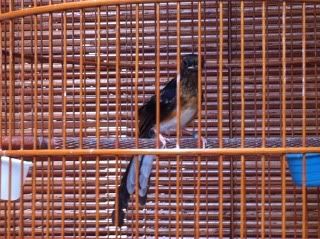
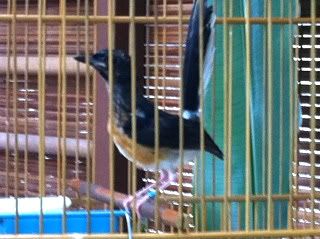
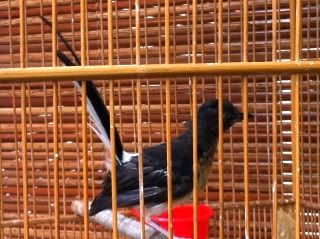
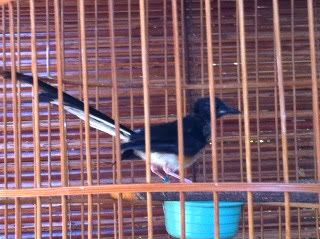
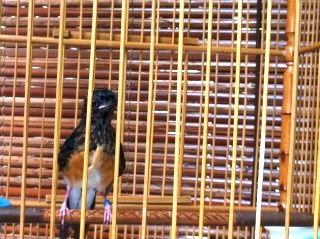
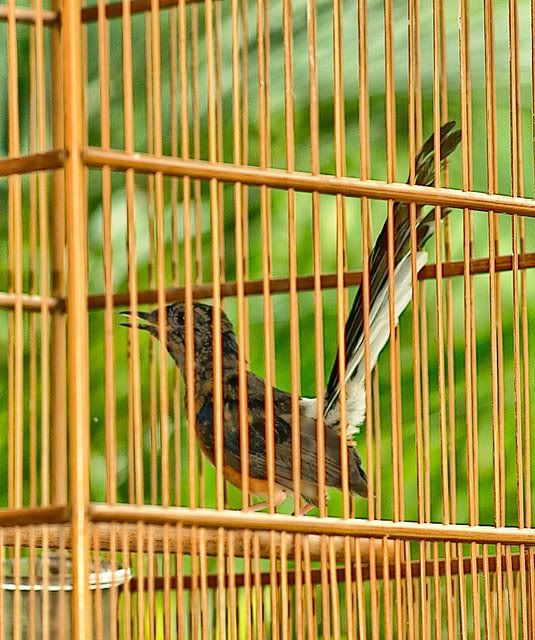
Take a look at the tails of the taimong below.


You should be able to see that the feathers of the tails seem to match those on the other parts of the bird. This tells us that the tails are genuinely taimong tails. The taimong's tails are usually brownish to match the body feathers. If the tails are dark and especially if they have some shine to them, the tails are almost invariably not taimong tails.

You will also see that the visible parts of the primary tails appear to be semi-transparent. From this we know that the bird is "thin-feathered" which is a very desirable quality in a shama. The thicker feathers make the bird seem bulky. Such birds are also slower moving and less likely to have a good display.

The head and neck are of the type that I look for - a well proportioned head on a slender neck. The taimong also has a cocky look about him. You can't really see his legs but they are long and this makes the bird look more elegant.

Years ago, I asked John Yim how I could assess the loudness and aggressiveness of a male shama if he is not singing. He said that I should listen to the tek tek sound the bird makes. The louder the sound the more aggressive the bird and the louder the song. On the basis of this test, I would say that the taimong is very aggressive. I have heard it sing and I think its song is developing very well. This is of course not surprising since there are many teachers in my home that it can learn from.

All in all the taimong looks promising but we will only know after the molt if it fulfills its promise. I will try to provide an update.[/b]

For those of you who are still looking to acquire a taimong, I hope the above helps.

Choosing a taimong

Posted: Mon Aug 20, 2007 1:53 pm Post subject: Re: Choosing a taimong

Hi David,

I notice that this period is a good time to choose a taimong. Thank you for listing down the criteria to choose a taimong. In fact, I have bought two taimongs recently. Would you be able to share with us how do you care for your taimong and make it molt earlier? Thank you.

God bless you!

Cheers!
Birdnie

Posted: Mon Aug 20, 2007 3:20 pm Post subject:

--------------------------------------------------------------------------------

I would not advise that any attempt be made to try to get a shama to molt earlier than it normally would. This applies to both adults and taimongs. The development and yearly cycle of the bird is determined by the hormones that the body releases. If the cycle is interrupted or disturbed, eg by the bird molting before it is time to do so in the yearly cycle, the body may not (after the molt) produce the hormones in sufficient quantity for the next stage of the bird’s life during the year.

In the normal yearly cycle, the shama will decline in song and display, molt, then there is a rise in song and display as the hormone testosterone is released into its system, then mating and looking after the chicks as the testosterone is replaced with prolactin and then gradual decline into molt again as the hormone for molt takes over.

I don’t know if you have had personal experience of a shama not coming into form after the molt. This happens because the bird has not had a good molt due to inadequate nutrition or an unsuitable environment and testosterone is not released into the system after the molt as it normally would. Studies have established that this hormone is required for the bird to sing and even females will come into song if they are injected with this hormone.

So let your bird molt naturally. Feed it with a balanced diet which you can read about elsewhere in this Forum.

Most taimongs will tame quite readily. If yours is a little wild, offer it tidbits daily and it should soon become tame.

Bear in mind that in the forest, a taimong that has been weaned will be attacked by the parents if it ventures into their territory while they are raising another brood. The taimong will therefore hide on the outskirts of the territory where he can hear the father and other birds and learn their songs. It is important that your taimong hear the songs of other shamas but, like the wild taimongs, the songs should be heard from a distance. The taimong’s cage should not be placed close to an adult shama’s.

If a tutor is not available, a taimong should not be kept as it will be unlikely to develop a full repertoire of songs. I find that shamas don’t learn much from recorded songs on the CD. I think this could be because the CD just cannot reproduce the high notes in the natural song. I have carried out trials on this. Amongst others, I purchased CDs that were supposed to teach song birds to whistle. My birds did not learn any of the songs. However, if they hear the live songs of birds or humans, they will quite readily pick up the tunes.

I wish you joy and enjoyment with your shamas.

David

Posted: Mon Aug 20, 2007 8:26 pm Post subject:

--------------------------------------------------------------------------------

David de Souza wrote:
I would not advise that any attempt be made to try to get a shama to molt earlier than it normally would.


Hi David,

Thank you for your advice. I have read your web site www.shama.com.sg under "Chick Development" Section - The plumage of the chicks will be drab with yellow spots. Between 2 to 6 months of age they will commence to molt and their drab plumage will be gradually replaced by adult plumage. My chicks commence to molt at about 2 months of age but those of other breeders tended to molt much later. We used to think that this was because my chicks were mostly kept outdoors whereas theirs were kept indoors in cages. However, when my friends fed their chicks the same vitamins and supplements that I was using, their chicks also tended to molt earlier. We have now concluded that healthy chicks tend to molt much earlier because their robust health enable them to do so."

Based on the above, I thought I would like to clarify how manage to molt the taimong earlier and what vitamins and supplements you feed your taimongs?

BTW, I really learnt a lot from your website and your contribution to MBF. Appreciate it.

May God bless You!

Cheers!

Posted: Mon Aug 20, 2007 8:51 pm Post subject:

--------------------------------------------------------------------------------

Thanks for your kind comments. I have mentioned in a post on this forum that my taimongs tend to molt earlier than those of others and that I attribute this to proper nutrition and care. This is different from feeding the taimong with with the main aim of trying to get it to molt earlier. The shama, regardless of whether it is a taimong or an adult will tend to delay its molt if there is insufficient nutrition to enable it to have a proper molt. Feeding the shama proper nutrition is something that should be done to ensure proper development and molt at the appropriate time. I think I misunderstood you when I replied earlier.