Showing posts with label 2011 Season. Show all posts

Wednesday, June 22, 2011

Flame

Photobucket

Photobucket

Friday, June 17, 2011

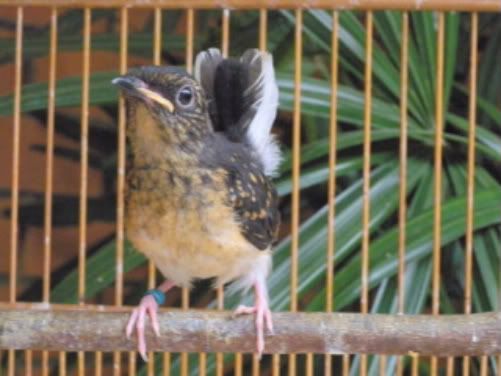
Iphone photo of Ozzie's son at 25 days of age:

Photobucket

Monday, June 13, 2011

Miscellaneous

Photos taken over the weekend


Photobucket


Photobucket


Internet Fraud
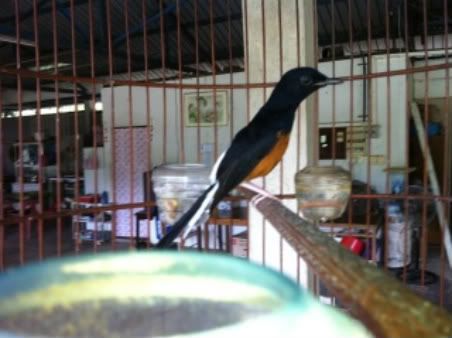
Buyers of shamas should beware of purchasing based on what they see on the internet. Make a Google search of "jual murai lomba" (selling competition shama).  Click on the video at the top of the page and you will see a recording of a shama that is being offered for sale by someone in Indonesia.  The seller claims that the bird is a Medan shama that is super ready for competition.

Actually, the video is my recording  of Skyhawk that was copied from the internet.  Needless to say, the person offering the shama for sale is in no position to sell the bird and any money that is sent will result in disappointment.


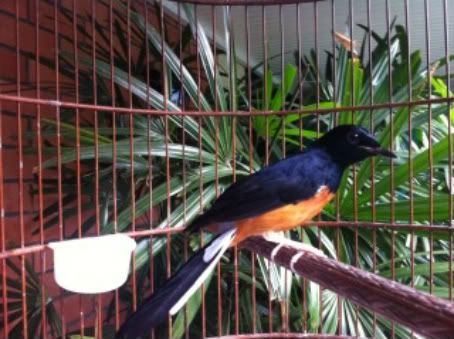
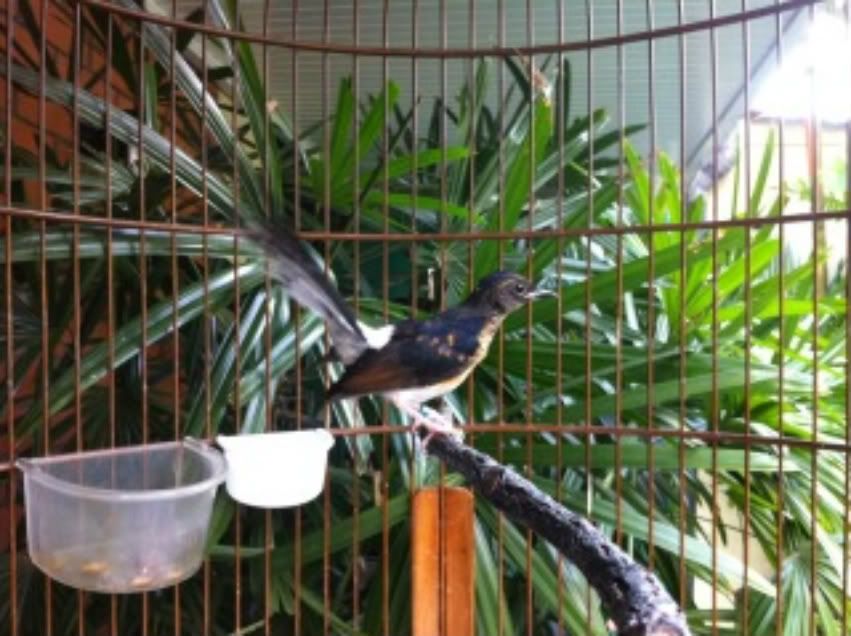
My new shama
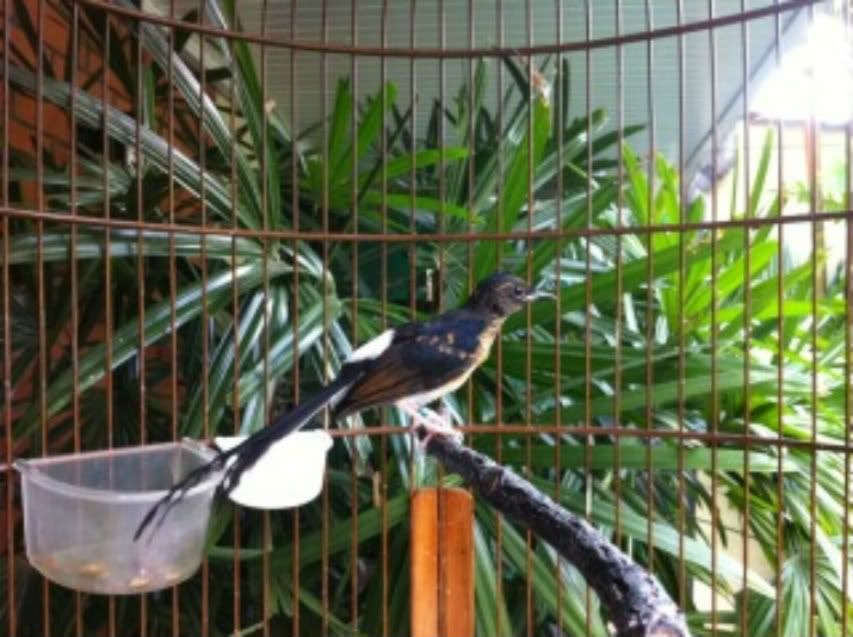
Yesterday, I bought the male shama below.  I was with Alan in the morning when he  mentioned that the bird was available for sale.  I always like to view shamas that are for sale and I went with Allen to see it.

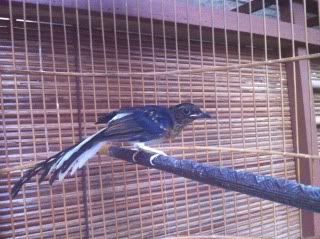
It was undergoing the molt from juvenile to adult plumage.  Its body had completed the change but the tails had a long way to grow still as they were only about 4".

I estimated the age of the bird at 6 to 7 months.  I liked its character and structure but unless the primary tails exceed at least 9" when fully grown, I would not want to use it as breeding stock.  I decided to take a chance and acquired it.

Photobucket


Photobucket

Thursday, June 9, 2011

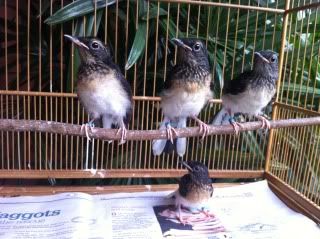
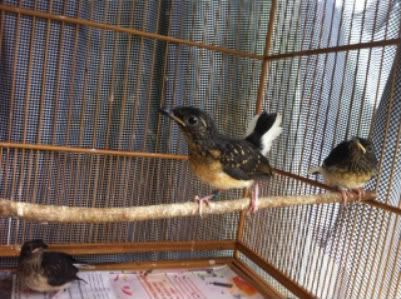
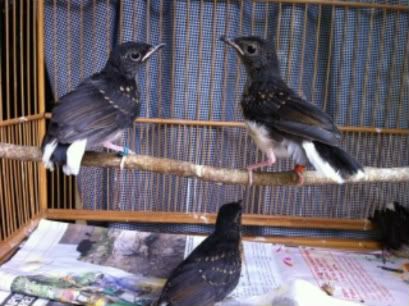
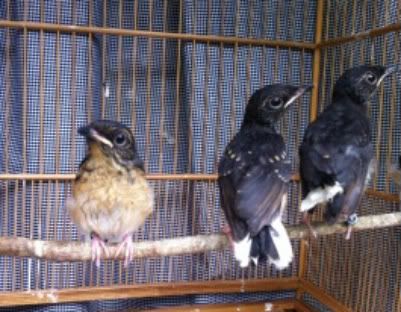
Pretty Boy's chicks from the 2nd nest at about 17 days of age.  Photos taken with iphone.

Photobucket

Photobucket


Photobucket


Photobucket

Wednesday, June 8, 2011

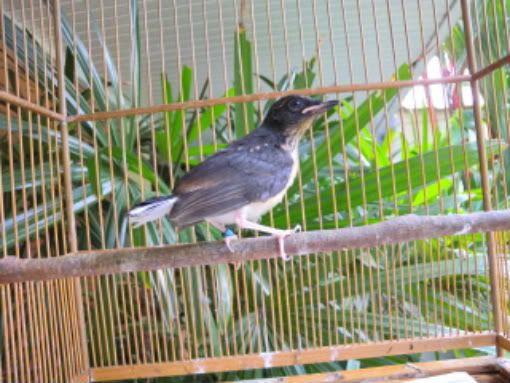
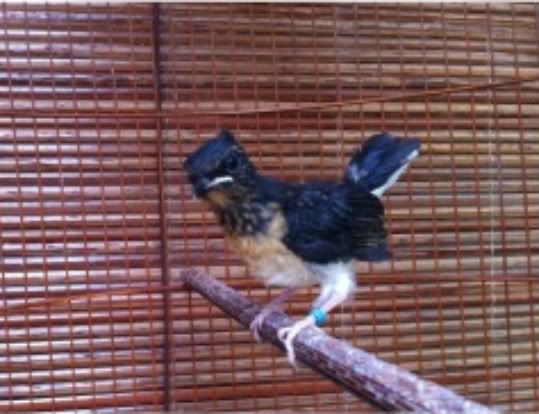
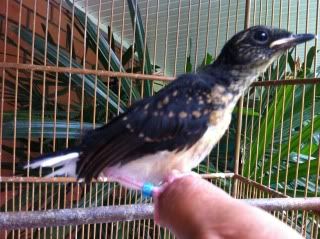
Flame at 68 days of age.  Photos taken with iphone.


Photobucket

Photobucket

Friday, June 3, 2011

Breeding

I don't know if other shama breeders in Singapore are experiencing the "problem" that I have this year.  Usually, the ratio of male and female offspring is about equal.  So far this year, the ratio for me from 4 pairs is almost  90% males.  This is no doubt a happy problem but I would like to know if there is a rational explanation for the disproportionate number of males this year.

It could be the somewhat freak weather conditions that we are experiencing nowadays.  In previous years, I would see the mynahs in my garden look for nesting material from early January.  This year, while the mynahs still come to my garden, they don't appear to be courting and looking for material to build their nests.  My guess is that the unpredictable violent storms in the first quarter of this year must have resulted in the repeated destruction of many nests and this has upset the hormonal cycle of the mynahs.

I mostly breed my birds in outdoor aviaries and due to the uncertain weather conditions, I only started pairing my shamas in March.  Nowadays, I am not in a hurry, knowing that there is more than sufficient time to take several clutches from the birds from March to August and beyond if I want to.

Thursday, May 12, 2011

This morning I did something I had not done in a while.  I transferred a mated pair with their nest-box (and an egg) from their garden aviary to my only indoor aviary.  

Before I explain why, I should mention that prior to the year 2000, I would regularly transfer pairs with eggs or chicks from my home to that of my close friend, Roland Wee.  He lived in a bungalow about 100 metres from my home and we had an arrangement that I would mate the birds and then transfer them and their eggs or chicks to his home for him to care. This went on for about 3 years.  What we did seems crazy in retrospect, but we never had any problems with the birds.

Nowadays, Roland no longer keeps birds and he has little interest in them.  We do meet though and have a meal every once in a while.
 
Roland and I used to band our chicks with the initials “R&D”.  I still use these bands as they are the ideal size for shamas and I cannot get this exact size anymore.

The pair that I transferred to the indoor aviary had been together for some time in the garden aviary.  Although the nest was built, there were no resulting chicks.  I attribute this to the male being wild-caught and not being used to the close proximity of other male shamas.

I had got him some time last year through my very good friend William.  The owner had obtained the bird from William on the promise that if I wanted it, he would let me have it at his cost.

After William introduced me to the owner, I inquired, how much he would want for the bird.  I knew that he had purchased it at William’s cost price of S$1,800.00.  He had also molted it and kept it for some time. 

He said that the price was not important and that he was merely fulfilling his promise to William in agreeing to let me have the bird. I asked if it was OK for me to take the bird at S$2,000.00.  He readily said “yes”.

I was touched by his sincerity and wanted to reciprocate. I told him that I would mate his bird to one of my females and, in addition to paying him for it, I would give him a male chick from the pair.  It was therefore important to me that his male produces at least one male chick.

And so I took the bird.  He has beautiful curved 10” tails,  He also has good structure, a strong character and good song.  After his molt in my care, I placed him in an outdoor breeding aviary with a suitable female.  Like I said, the pair had no resulting chicks. 

I transferred the pair to the indoor aviary because I have had the most success in breeding shamas in it.  I think there are 3 reasons for this.  Firstly, being indoors, the temperature is relatively constant.  Secondly, I don’t keep in-form shamas close by when I use the indoor aviary for breeding.  Finally, I can observe the pair from the comfort of a chair opposite the aviary and this allows me to make adjustments to their care and nutrition if necessary.

I will write further if I have anything to report.

Wednesday, May 11, 2011


Skyhawk's chick at 15 days of age.  He is only 4 days out of the nest but he is already showing attitude.


Photobucket

Monday, May 9, 2011

As a serious breeder of shamas, my aim is not to produce birds in quantity.  Neither am I able to do so as I have space constraints. Rather, through careful selection of breeding stock, I try to develop a small strain of shamas that is able to breed true to the type I have in mind.

The efforts that I have invested over  many, many years, have now resulted in a strain of birds that is readily recognizable as descended from the line of shamas that originated from Godfather - i.e. a strain characterized by males with generally long soft curved tails, good structure, song and a strong character.

Because my focus over the years has been on breeding and not competition, there was speculation by some hobbyists that captive bred shamas may not be able to compete in the arena on equal terms with wild-caughts.  If there was any such belief, it has been dispelled by the consistent successes of my birds in competitions since towards the end of last year.

Actually, even without the competition successes, a little common sense and research would have established that such claims cannot be true.  In fact, if a breeder knows what he is doing, over time, the successive generations of captive breds should develop to be far superior in the characteristics that are being sought than those in the wild. This is proving to be the case with shamas as my birds have improved over the years in the characteristics that I seek.

This year, I have so far had chicks from 4 males that I had not bred from previously.  They are Alpha, Skyhawk, Ozzie and Pretty Boy (my favourite shama).  Except for Alpha's chicks, the chicks from the others are presently much too young to make any serious assessment. Even with Alpha's chicks, any assessment at this time must be tentative as they are still immature and have much development ahead before they are fully developed taimongs.

For my strain of birds, I would regard a taimong with fully grown tails of 6" or more as having very long tails.  For instance, the longest tailed taimong I ever bred was Max and he had taimong tails of 6.4 inches.  After his first molt, the tails were about 12.4" and they are now about 16".

This does not mean that a chick with tails less than 6" will eventually have tails below 12".  From my experience and only with regard to the strain that I breed, even a chick with taimong tails of 4.75" (such as Super Model), can have tails exceeding 12" by the third molt.  Where the taimong tails are 6" to 6.4", I can almost predict that the tails after the first molt will be 11.75" to 12.4" with the eventual length after the 3rd or 4th molt to be from 13.5" to 16".

Over the past weekend, my friends and I have been pleasantly surprised by the way one of the chicks from Alpha's first clutch is developing.  Yesterday (Sunday), these chicks were only 41 days old and at this age, the average length of the primary tails of a chick with the potential for 6" taimong tails should be only around  3.25".  However, I measured the longest tailed chick from Alpha's first clutch at an unbelievable 4.25" or about 30% longer than the tails of the usual long-tailed chick of the same age. Moreover, the tips of its white tails are in line with the black tails.  This means that even the white tails are already substantially longer than those of the average wild-caught taimongs.  It also suggests that there is still a long way to go before the primary tails are fully grown.

How long the taimong tails of Alpha's above chick will eventually be is speculative at this time.  Generally, the taimongs grow their tails at the approximate same rate of 0.6" per week.  Those with short tails will stop growing sooner whilst the longer tails will continue to grow over a period of about 2 1/2 months or slightly more than 10 weeks.  On this basis, a long-tailed taimong will have tails of about 6".

 In the case of Alpha's above chick, the rate of growth has been about 0.7" a week.  This is phenomenal growth and if it continues, I may well have my first taimong with tails over 7".  Of course, tail length is not everything and the bird will also need to have the other characteristics that are sought but this chick does seem to have the other required characteristics.

The uncertainty of what will be produced from year to year makes breeding rewarding.  This year is proving to be especially exciting.
Tuesday, May 3, 2011

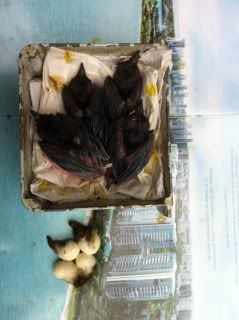
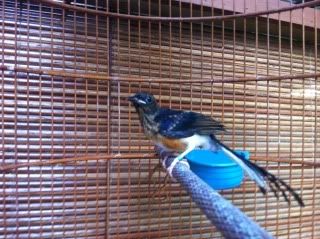
Sky Hawk's chicks at 8 days old.  The chicks have just been fed and the tissue paper has not as yet been changed.  The excreta at the bottom of the photo shows  what should come out from healthy chicks at this age.

Photobucket


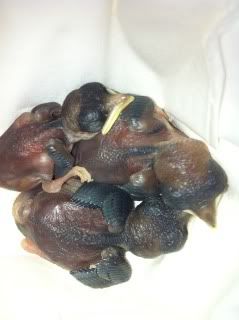
Pretty Boy's chicks at 2/3 days of age.
Photobucket


The newly introduced pair of Max and DDS138.
Photobucket

Friday, April 29, 2011

Below is a chick from Ozzie's first clutch of 3 chicks.  It is 17 days old.

Photobucket

Monday, April 25, 2011

First batch of chicks

I started pairing the shamas in mid-March this year because of the uncertain weather.  Below is my first batch of chicks from Alpha.  They are about 27 days old.  Looks like 3 males and 1 female.

Photobucket

Friday, April 1, 2011

Alpha has had a nest of 4 chicks.  This is the first time that I have bred him.  He is Ballet Dancer's son from 2009 and is now less than 2 years old. I wanted chicks from him as he has a strong character, long soft curving tails and an excellent display.

When he molted from juvenile, he did not shed his tail feathers.  I had several unsolicited offers to purchase him but I was not keen to part with him as I felt that he might turn out to be something special if he grew long tails.

When he subsequently had his 2nd molt and shed his juvenile tails, his new adult tails exceeded 13".  It will be interesting to see how long his tails will be after his next molt.

Yesterday, I took his chicks from the nest as my inexperienced helper thought, whilst I was at work, that the parents were not feeding them enough.  In fact, Alpah and his mate were together feeding the chicks well.  Anyway, at 3 days of age the chicks are not too difficult to look after.  They are all doing well and I hope that there will be a spectacular shama from amongst them.

Thursday, March 31, 2011

All my breeding aviaries, except 1, are outdoors so I usually wait until the rainy season is over before introducing the pairs.  Breeding was delayed this year as the rains fell until towards the end of February.  The skies have now cleared and breeding has commenced.

One interesting thing is that in past years, some of the females commenced brooding after only laying their 2nd or 3rd egg.  This always poses a problem as the earlier eggs hatch first and the mother is sometimes confused as to whether she should continue to sit on the unhatched egg(s) or feed the chicks.  This year though, every female so far has commenced brooding only after laying the 4th egg.

I had intended to reserve my only indoor aviary to prepare my birds for competition but I eventually decided to use it for breeding as it is my best aviary for breeding.  I placed Sky Hawk and a female in it.  She laid her 4th egg this morning and commenced brooding.